Posts with #MetaAnalysis

#MetaAnalysis

Public posts on X that use #MetaAnalysis.

Related hashtags

  1. Ana Carolina Steiner@anacarolsteiner
    Meta-Analysis Academy has completely transformed my career by giving me the tools and comprehensive knowledge to conduct systematic reviews and meta-analysis with autonomy! The best offer of the year is coming this Black November! Use the link to pre register and learn more
    Download
    7213226
  2. Meta Analysis Academy✓@metaacademy_ofc
    You are in luck! You just found the best offer to join Meta-Analysis Academy. For the first time, you’ll be able to get our top-rated programs in a single bundle, with more included than we’ve ever offered, at a fraction of what each one costs on its own. 📅 November 8 ⏱️12 PM New York time This is a one-time release, and it won’t return in this form. Be there when it opens. Comment “META” to get the live link. #Research #Match2027 #USMLE
    Download
    101367
  3. Juanlu_CabanillasGar@JuanluCaba_Unex
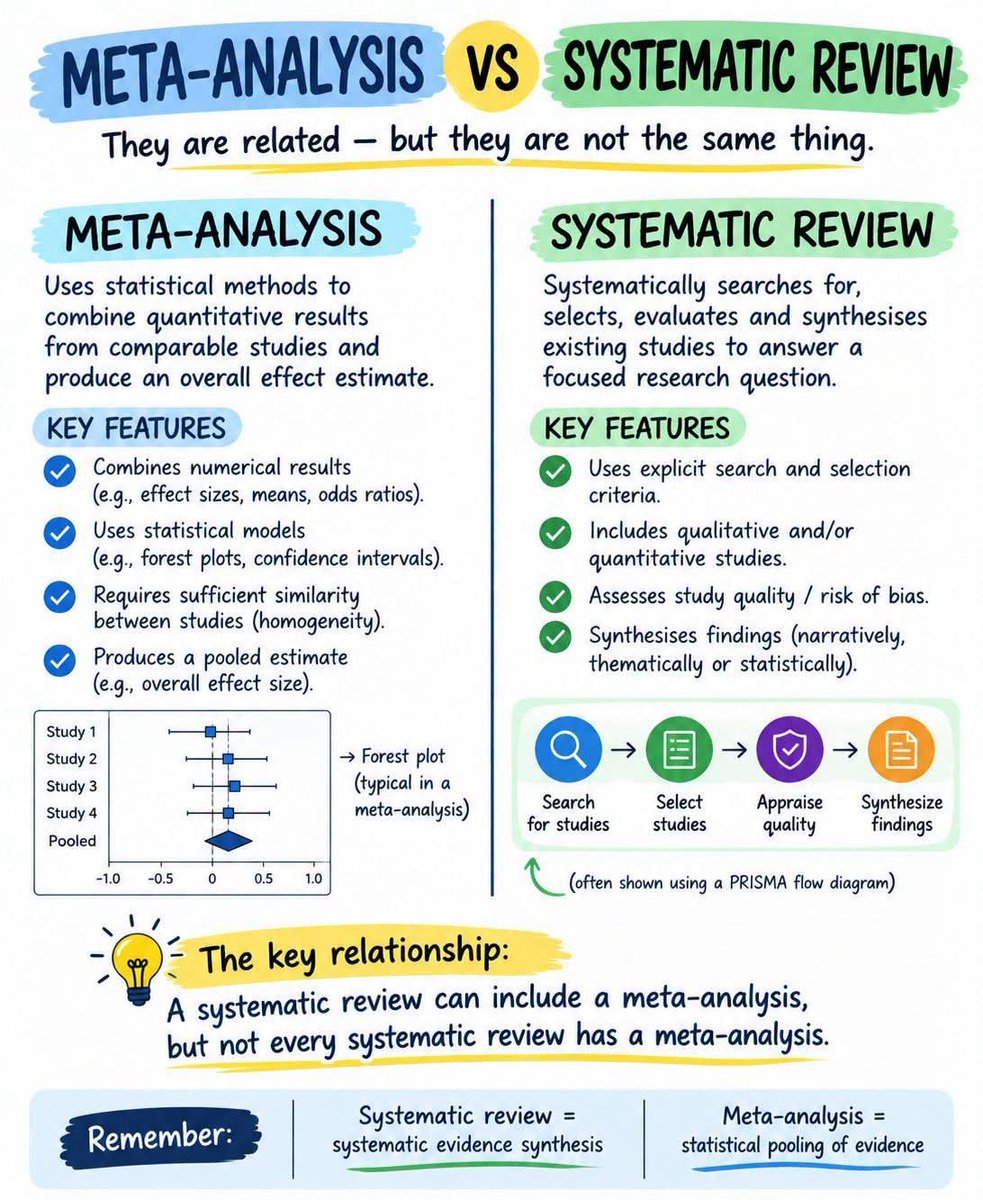
    Systematic Review vs Meta-Analysis A systematic review gathers and evaluates all relevant evidence. A meta-analysis statistically combines the results. 📚 Review = synthesize evidence 📊 Meta-analysis = pool results #ResearchMethods #MetaAnalysis
    Download
    2471514.1K
  4. Northbeam@northbeam
    New customer acquisition on Meta is getting cheaper, contrary to popular opinion. When looking at average nCAC across all 1,000+ ad accounts tracked by Northbeam, we can clearly see that costs dropped by as much as 33% in Q3 year over year. This is tracking billions in ad spend, filtered for accounts that only appear in both quarters, for a fair comparison. How is this possible? A few hypotheses: 1. Public opinion (especially on this platform) is quick to blame Meta. Anecdotal evidence is NOT indicative of an actual trend - you must bring data. This is kind of our whole thing at @northbeam. 2. Meta has made significant algorithmic changes this year, as we've seen in past charts shared on this channel. It seems like these changes are working. Or at least, people are adapting. 3. I do not expect this drop to continue forever. Although we have eschewed all seasonal trends here, CACs will increase during BFCM and stay elevated through Christmas. 4. Targeting new customers has gotten easier. Northbeam Apex and Meta's incremental attribution have improved new customer acquisition performance across our advertisers. 5. So it's not just prices - it's HOW we are targeting new customers. Because we're better at targeting, it's getting cheaper over time. 6. These attribution models only improve with time. Therefore, the downward trend seen below. 7. The huge spike is Amazon Prime Day + Father's Day + 4th of July, which were awkwardly placed near each other this year. 8. Meta remains undefeated. We had some growing pains there, but this chart clearly shows that on average, new customer acquisition is improving, at least across Northbeam advertisers. 9. Everyone is listening to people like @9operators when they hammer new customer acquisition as a key priority for your business, and therefore folks are getting better at it. 10. Something happened this summer. Some kind of cultural vibe shift mixed with macro changes. Folks are just... happier? And happier people buy more stuff. You probably feel it too. 11. Macroeconomic challenges around gas prices, shipping disruptions, and exchange rates have culled a generation of DTC businesses, which has decreased competition somewhat. Lots of businesses folding this year. 12. Meta is actually listening to us and building a platform that permits us to efficiently and cheaply target new customer acquisition. Granted, they are still pushing AI that will make many of the people reading this message redundant. 13. The loudest folks online are the ones having problems with Meta Ads. I know many killers on here who don't ever speak to their own performance and are doing great right now. As a wise man once said: "The realest ecomm operators move in silence like the 'g' in lasagna." What are you seeing in your data? All charts and analysis by @BryanBumgardner 🛰️
    Download
    1377923.4K
  5. Meta Analysis Academy✓@metaacademy_ofc
    You’ve got an idea brewing 💡 You’re refining your question, maybe halfway through screening… But now it’s time to find the right mentor. Do you cold-email an outside PI or apply to work with a Meta-Analysis Academy Expert? Here are five reasons why our Experts might be your best move #MedTwitter #Experts
    Download
    113329
  6. Psychedelic Alpha✓@Psyched_Alpha
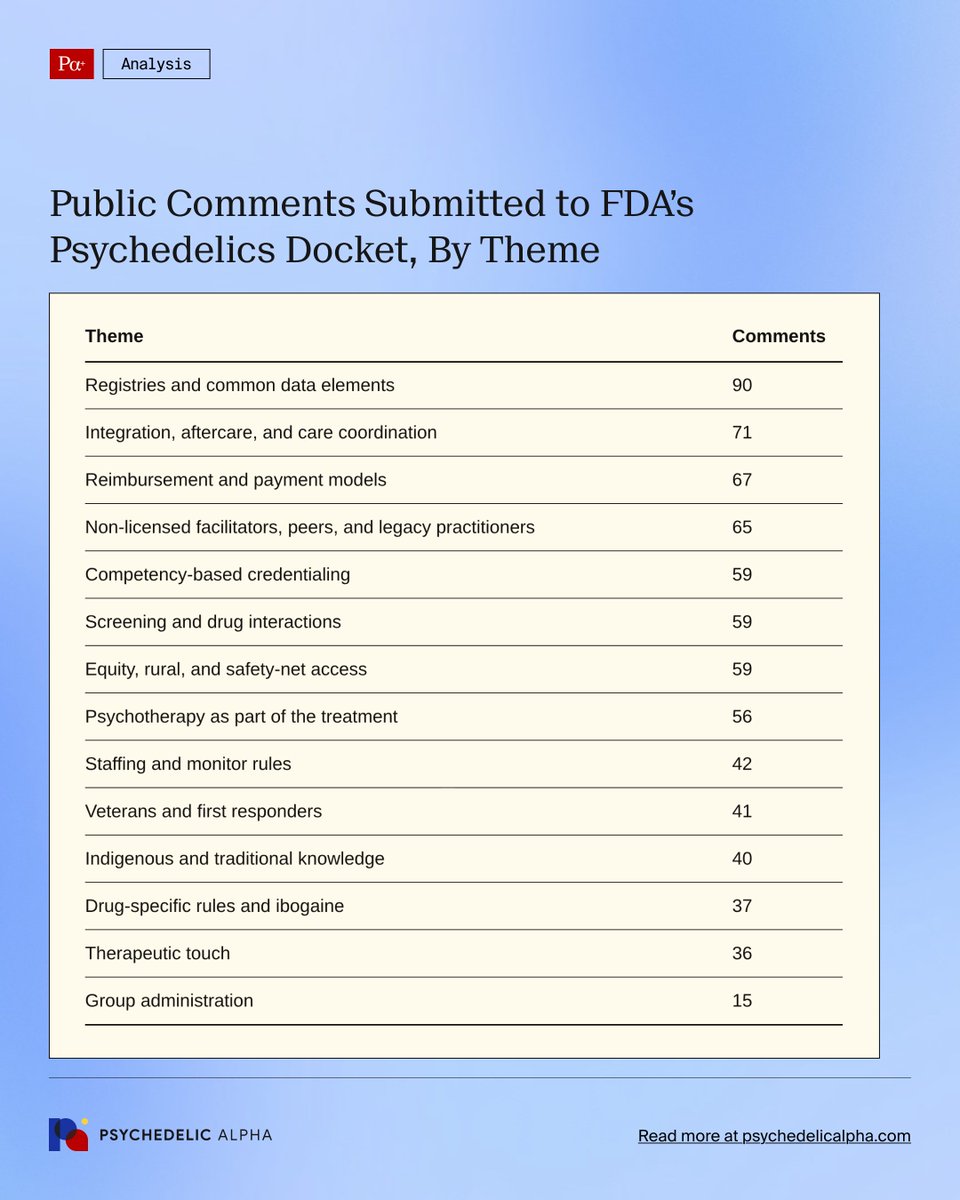
    FDA received over 600 comments from the public on its psychedelics-focused docket. In an analysis published earlier this week, we parsed through them to produce a meta-analysis and a deep dive. Here, we show the broad themes that emerged across many of the submissions. Read more on our website:
    Download
    118766
  7. Selçuk Korkmaz@selcukorkmaz
    1/ #MetaAnalysis is a method that combines results from multiple studies on a similar topic to draw a more robust conclusion. Think of it as a "study of studies". It’s like pooling wisdom from multiple places to get a clearer picture. 2/ Why is it important? Well, individual studies often have small sample sizes and can show varied results. Meta-analysis increases the power and precision of the estimate by pooling data from several studies. 3/ The basic steps involved are: a. Define the research question b. Search for relevant studies c. Select studies to include d. Extract data e. Analyze and combine the results 4/ The first step is defining the research question. You have to be specific about what you want to know. For example, instead of asking “Does exercise affect mental health?”, a more specific question could be “Does aerobic exercise reduce anxiety in adults?” 5/ Next, you search for all the studies that might answer your question. This involves looking at published articles, conference papers, and even unpublished studies. You don’t want to miss anything! 6/ Now, you need to decide which studies to include in your meta-analysis. You can't just include everything! Studies need to be similar enough and of good quality. You set criteria for this beforehand to make sure you are being objective. 7/ Once you have your studies, you extract the data you need from them. This might include the size of the effect (e.g., how much did anxiety decrease), the sample size, and other relevant information. 8/ Finally, you analyze and combine the results. This is where the magic happens! You use statistical methods to combine the results from all the studies into a single estimate of the effect. 9/ There are different models to combine results. The ‘fixed-effect model’ assumes that there is one true effect size that is the same in all studies. The ‘random-effects model’ assumes that the true effect can vary from study to study. 10/ However, meta-analysis has its limitations. For example, it is susceptible to publication bias - the tendency for studies with positive results to be more likely to be published. This can lead to an overestimation of the effect. 11/ Also, the quality of a meta-analysis is only as good as the quality of the studies included. If the original studies have flaws, those flaws will carry over into the meta-analysis. 12/ In summary, meta-analysis is a powerful tool for combining results from multiple studies to get a clearer picture of an effect. However, it has its limitations and should be conducted and interpreted with caution. #Statistics #DataScience
    Download
    86624142K
  8. Psychedelic Alpha✓@Psyched_Alpha
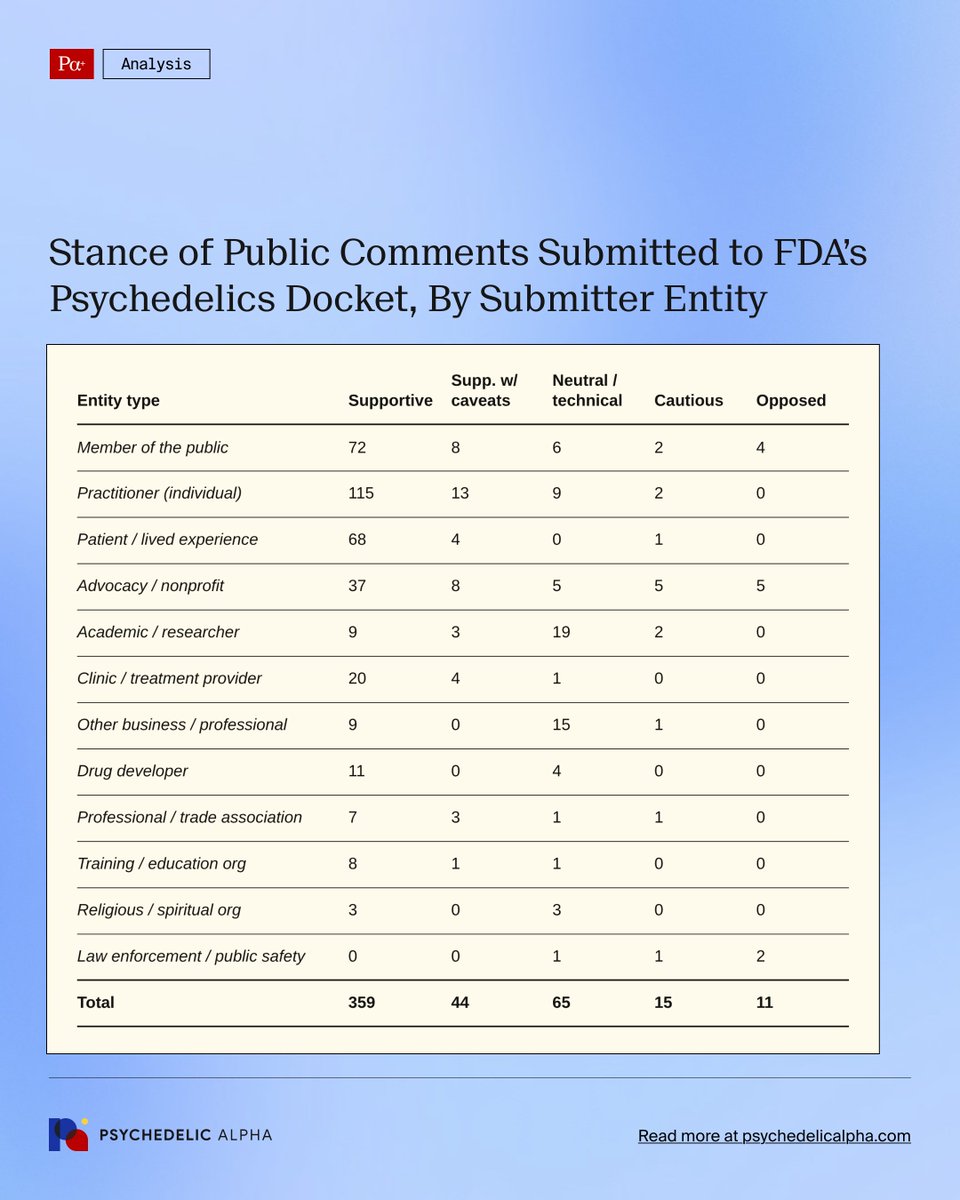
    FDA received over 600 comments from the public on its psychedelics-focused docket. In an analysis published earlier this week, we parsed through them to produce a meta-analysis and a deep dive. Here, we show the broad sentiment of each unique submission, segmented by submitter entity type. Read more on our website:
    Download
    0214721
  9. Mike Cheung@mikewlcheung
    I gave a presentation yesterday on using #structuralequationmodel SEM-based #metaanalysis to fit various models, including random-effects, multiplicative error, hybrid, location-scale, nonlinear, multivariate, and more. YouTube:
    22915111.7K
  10. CoreSR✓@CoreSRR
    Owen & Abrams (BMC Med Res Methodol) let the log HR change linearly with log(time), then pool both terms. Gastric cancer PFS: constant HR 0.78, but 0.83 at 6 months and 0.99 at 3.5 years. Neat. But with 9 of 13 melanoma trials extrapolated, is a 5-year HR data or assumption?
    10017
  11. HeartRhythm@hrs_journal
    Glucagon-Like Peptide-1 Receptor Agonists and Risk of Arrhythmias: A Network Meta-Analysis
    Download
    313312.7K
  12. CoreSR✓@CoreSRR
    Gloukhman et al. (Syst Rev) tested two text-mining screeners on 3 psychology meta-analyses. Recall: 62.5% to 99.3%. The 99% came where humans hand-screened 41–46% of records for training; elsewhere 10–17%. Metrics count that training set too. How much is model, how much human?
    1007
  13. Show more posts