Posts with #OptimalControl

#OptimalControl

Public posts on X that use #OptimalControl.

Related hashtags

  1. Mahdi E Kahou@MahdiKahou
    This video demonstrates the neural network solution to the Ramsey–Cass–Koopmans model. Each frame represents an epoch of the optimization process. Code: #OptimalControl #DeepLearning
    Download
    Hwan Lin @hwanclin
    @MahdiKahou @jlperla In addition to traditional methods, using PINN, we can solve the Ramsey ODE model too. How do you compare Ridgeless Kernel to PINN?
    32617826.9K
  2. Hwan Lin✓@hwanclin
    @MahdiKahou
    @MahdiKahou @jlperla In addition to traditional methods, using PINN, we can solve the Ramsey ODE model too. How do you compare Ridgeless Kernel to PINN?
    10624.6K
  3. Yann LeCun✓@ylecun
    Indeed, I do favor MPC over RL. I've been making that point since at least 2016. RL requires ridiculously large numbers of trials to learn any new task. In contrast MPC is zero shot: If you have a good world model and a good task objective, MPC can solve new tasks without any task-specific learning. That's the magic of planning. It doesn't mean that RL is useless, but its use should be a last resort.
    Antoine Leeman @antoine_leeman
    Yann Lecun favours MPC over RL? Interesting! What about data-augmented MPC? @ylecun #nmpc2024
    84111942266K
  4. Davide Scaramuzza✓@davsca1
    Check out our latest work, "Actor-Critic Model Predictive Control: Differentiable Optimization meets Reinforcement Learning for Agile Flight," published in the IEEE Transactions on Robotics, where we reconcile #OptimalControl and #ReinforcementLearning, achieving the same super-human performance, but with superior generalizability, as our previous model-free deep RL! Code released! PDF: Code: Full Video: Model-free #ReinforcementLearning (RL) is known for its strong task performance and flexibility in optimizing general reward formulations. On the other hand, #ModelPredictiveControl (MPC) provides robustness, constraint handling, and powerful online replanning capabilities. In this work, we extend our previous AC-MPC paper (Romero, ICRA'24) by taking a deeper look at how both approaches can be unified. We introduce and extend Actor-Critic Model Predictive Control (AC-MPC), a framework that embeds a differentiable MPC inside an Actor-Critic RL architecture. This integration allows the MPC-based actor to perform short-term predictive optimization, while the critic facilitates long-horizon learning and exploration. We conduct a comprehensive study that highlights AC-MPC’s key advantages: - Better out-of-distribution generalization, both against unknown disturbances and changes in the quadrotor dynamics - Improved sample efficiency - A novel empirical analysis uncovering a relationship between the critic’s value function and the MPC cost function, providing deeper insight into their interplay. We validate our method in simulation and the real world on a quadcopter flying at superhuman speeds of up to 21 m/s, matching state-of-the-art model-free RL performance, and retaining the predictive structure of MPC for more reliable out-of-distribution behavior. Reference: Actor-Critic Model Predictive Control: Differentiable Optimization meets Reinforcement Learning for Agile Flight IEEE Transactions on Robotics (T-RO), 2025 PDF: Full Video: Code: Kudos to @roaguiangel, @EliJalbout, @realyunlong! @UZH_en @UZH_Science @UZHspacehub @AUTOASSESS_EU @ERC_Research @UZH_ai
    Download
    36241727.4K
  5. Davide Scaramuzza✓@davsca1
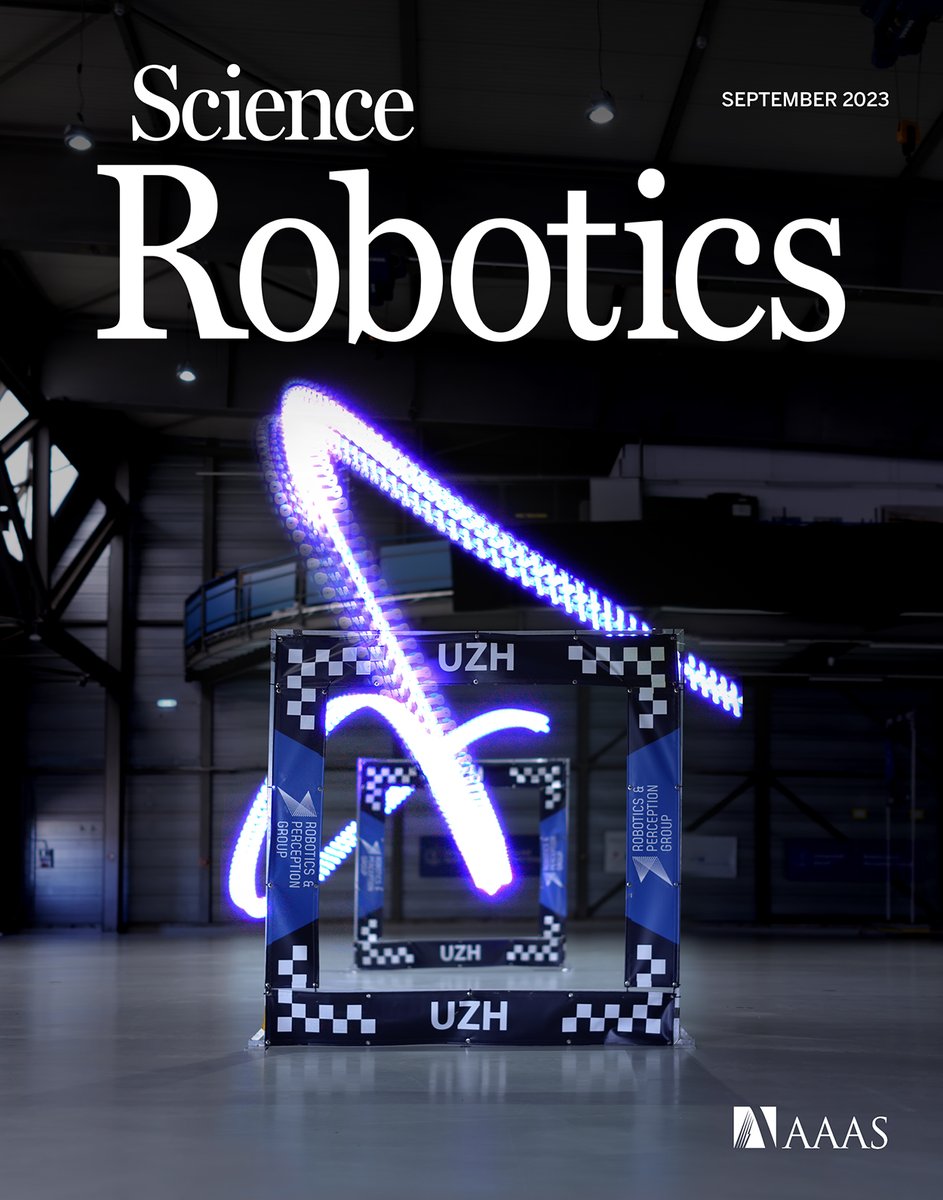
    Why can #ReinforcementLearning (RL) achieve results beyond #OptimalControl (OC) in many real-world robotics control tasks? We investigate this question in our paper published today in @SciRobotics, available Open Access: Video: RL's most impressive achievements are beyond the reach of existing optimal control-based systems. However, less attention has been paid to the systematic study of fundamental factors that have led to the success of reinforcement learning or have limited optimal control. This question can be investigated along the optimization method and the optimization objective. Our results indicate that RL outperforms OC because it optimizes a better objective: OC decomposes the problem into planning and control with an explicit intermediate representation, such as a trajectory, that serves as an interface. This decomposition limits the range of behaviors that can be expressed by the controller, leading to inferior control performance when facing unmodeled effects. In contrast, RL can directly optimize a task-level objective and can leverage domain randomization to cope with model uncertainty, allowing the discovery of more robust control responses. This work is a significant milestone in agile robotics and sheds light on the pivotal roles of RL and OC in robot control. Beyond the fundamental study, our work contributes an RL-based controller that delivers the highest performance ever demonstrated on an autonomous racing drone. Our drone achieved remarkable performance: peak acceleration greater than 12 g and peak velocity ~108 km/h, all within minutes of training with a standard workstation. Kudos to my coauthors @realyunlong, @roaguiangel, the pilots @captainvanover, @bmsthomas, and our supporters @ERC_Research, @m_schaepman, @UZH_en @UZH_Science, @UZHspacehub, @nccrrobotics, @aerialcore
    Download
    87841738.6K
  6. Show more posts