You may have heard about the Model Context Protocol and wondered how it lets AI tools connect to other tools, APIs, and systems.
Well, it's all thanks to MCP servers.
In this guide, @manishmshiva explains how MCP servers work and helps you build your own with Python and the FastMCP library.
The field of Cryptography is all about securing both data and communication between systems.
And in this course, you'll learn the basics like hashing, symmetric and asymmetric encryption, and more.
By the end, you'll have built a fully-functioning Python-based command line cryptography tool.
The future of software is code that reasons.
And learning Python is your first step in this direction.
In this video course, you'll learn Python fundamentals, NumPy, Pandas, SQL, Flask, LLMs, and everything else you need to dive into AI Agent development.
In response to the eMudhra / emSign certificate security incident we've published guidance for Python users to update CA certificates:
#security#Python#pki
Algorithms — Free PDF (472 Pages!)
Want to strengthen your problem-solving skills and become a better programmer?
This 472-page Algorithms book is a great resource for anyone interested in understanding how algorithms work and how to solve computational problems efficiently.
What you can learn:
✅ Algorithm design and problem-solving
✅ Time and space complexity
✅ Efficient approaches to computational problems
✅ A stronger foundation for Data Structures & Algorithms (DSA)
✅ Skills useful for coding interviews and competitive programming
Perfect for Python developers, computer science students, software engineers, and aspiring programmers!
Get the free PDF here:
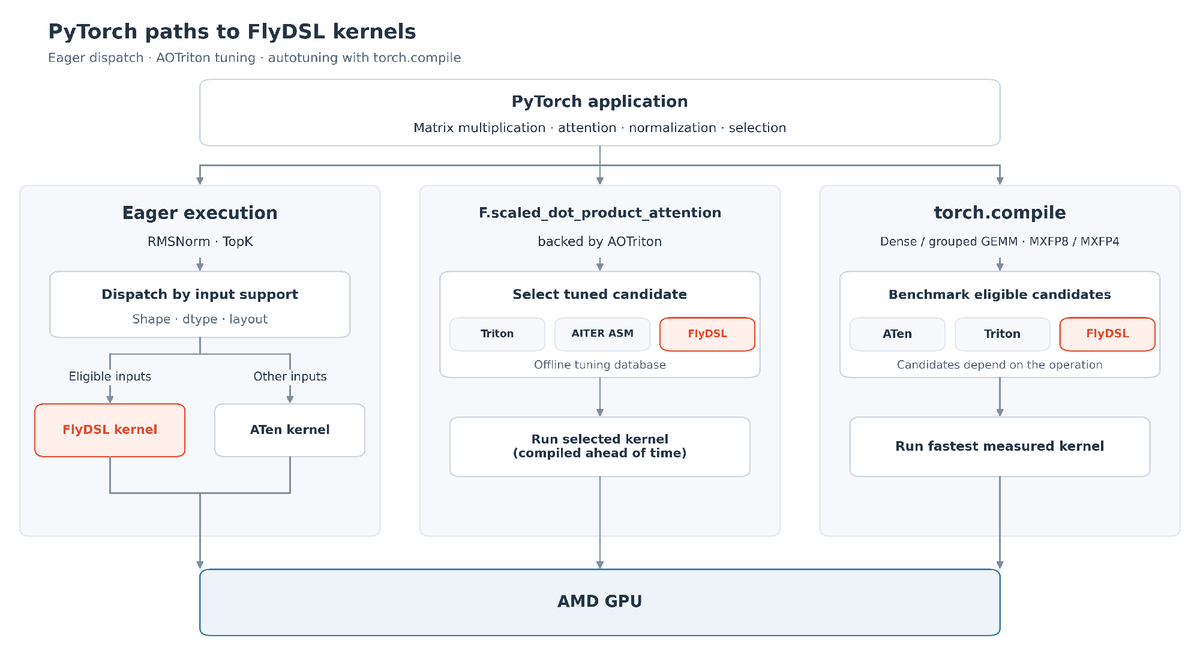
FlyDSL, an open source Python kernel DSL, now plugs into PyTorch on @AMD MI350-series GPUs via torch.compile and eager mode.
Up to 1.68x geomean scaled GEMM kernel speedups and up to 3.01x end-to-end #vLLM serving speedups.
Read more:
Python vs Cython: The Same Logic, Over 100× Faster!
Did you know that Cython can dramatically speed up Python code?
In this benchmark:
Pure Python: 7.37 seconds
With Cython: 59.5 milliseconds
That's approximately 124× faster!
What makes the difference?
✅ C-level variable declarations with cdef
✅ Compiled code instead of relying entirely on Python's runtime
✅ Reduced overhead in performance-critical loops
Pro tip: If your Python code spends significant time in numerical loops, Cython is worth exploring.
Results depend on the code, types, compiler settings, and hardware. Not every Python program will achieve this speedup.
Would you try Cython to optimize your Python applications?
Repost to help other Python developers discover this!
Follow @clcoding for more Python tips, coding challenges, and developer resources.
Blog:
Learn Coding by playing games
1. Kubernetes
2. DevOps
3. Linux
4. Git
5. Python
6. CSS & HTML
7. Cybersecurity
8. Mobile Coding (like Duolingo)
9. For Complete Beginners
10. 25+ Programming Languages