Posts with #diffusionmodels

#diffusionmodels

Public posts on X that use #diffusionmodels.

Related hashtags

  1. David@LiDavid2002
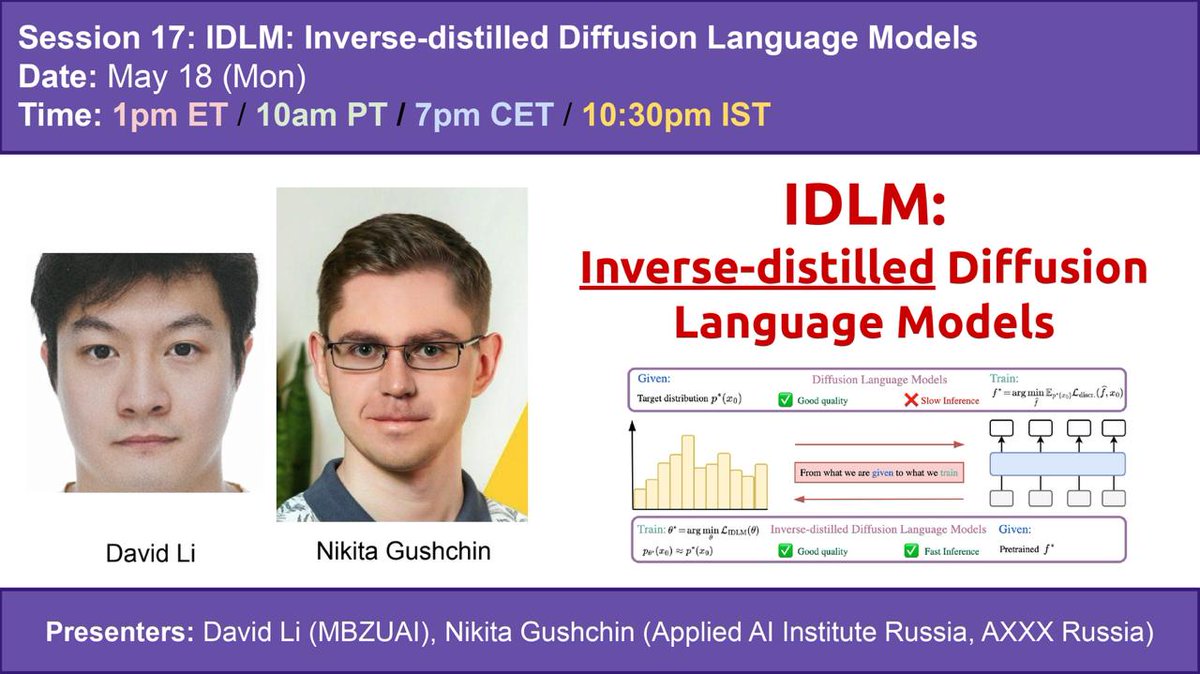
    🚀 Today, @iNikitaGushchin and I will be presenting our work on IDLM as part of the dLLM Reading Group! We’ll discuss the main ideas behind the paper, what motivated this direction, and why we believe it is an exciting step for diffusion-based language modeling.
    Download
    1391.6K
  2. David@LiDavid2002
    @LiDavid2002
    I also shared a brief overview of the core idea in my Telegram channel for anyone curious, you can check it out here: We’ll be happy to see everyone interested in diffusion LMs, generative modeling, or just curious about where this field is heading.
    100107
  3. David@LiDavid2002
    @LiDavid2002
    📄 Paper: 💻 Code: 📢 Invitation post: Many thanks to the organizers for the invitation, @jdeschena, @ssahoo_, @zhihanyang_! 🙌 #ICML2026 #DiffusionModels #LanguageModels #GenerativeAI #MachineLearning
    Discrete Diffusion Reading Group @diffusion_llms
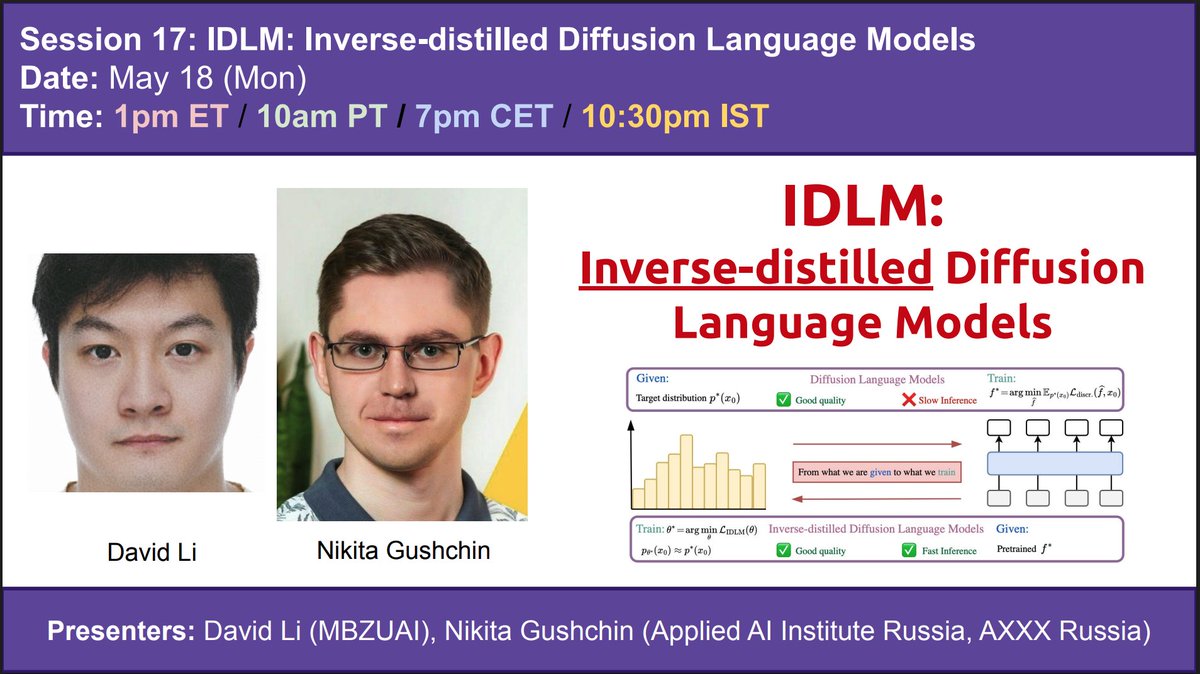
    📢 May 18 (Mon): IDLM: Inverse-distilled Diffusion Language Models 🤔Diffusion Language Models (DLMs) have recently achieved strong results in text generation. However, their multi-step sampling leads to slow inference, limiting practical use. 💡To address this, the authors extend Inverse Distillation, a technique originally developed to accelerate continuous diffusion models, to the discrete setting. However, this extension introduces both theoretical and practical challenges. 🔧To overcome these challenges, the authors first provide a theoretical result demonstrating that their inverse formulation admits a unique solution, thereby ensuring valid optimization. They then introduce gradient-stable relaxations to support effective training. 📊As a result, experiments on multiple DLMs show that their method, Inverse-distilled Diffusion Language Models (IDLM), reduces the number of inference steps by 4×—64×, while preserving the teacher model’s entropy and generative perplexity. This Monday, David Li ( and Nikita Gushchin ( will present their jointly led paper, which was recently accepted at ICML 2026. Collaborators of this work include: Dmitry Abulkhanov (@dabulkhanov_), Eric Moulines ( Ivan Oseledets (@oseledetsivan), Maxim Panov (@maxim_panov), Alexander Korotin ( Paper link:
    0110472
  4. Discrete Diffusion Reading Group✓@diffusion_llms
    📢 May 18 (Mon): IDLM: Inverse-distilled Diffusion Language Models 🤔Diffusion Language Models (DLMs) have recently achieved strong results in text generation. However, their multi-step sampling leads to slow inference, limiting practical use. 💡To address this, the authors extend Inverse Distillation, a technique originally developed to accelerate continuous diffusion models, to the discrete setting. However, this extension introduces both theoretical and practical challenges. 🔧To overcome these challenges, the authors first provide a theoretical result demonstrating that their inverse formulation admits a unique solution, thereby ensuring valid optimization. They then introduce gradient-stable relaxations to support effective training. 📊As a result, experiments on multiple DLMs show that their method, Inverse-distilled Diffusion Language Models (IDLM), reduces the number of inference steps by 4×—64×, while preserving the teacher model’s entropy and generative perplexity. This Monday, David Li ( and Nikita Gushchin ( will present their jointly led paper, which was recently accepted at ICML 2026. Collaborators of this work include: Dmitry Abulkhanov (@dabulkhanov_), Eric Moulines ( Ivan Oseledets (@oseledetsivan), Maxim Panov (@maxim_panov), Alexander Korotin ( Paper link:
    Download
    214369.9K
  5. Wujia@whb_zju
    Diffusion Models: 10 Detailed Takeaways for Application 1. "DDPM's core is just the start! To truly master diffusion models, you NEED to grasp DDIM's speed, SDE/ODE's flexibility. These shape modern architectures. Dive deep! #DiffusionModels #AIML #deeplearning
    201115
  6. Ye Zhu@szyezhu
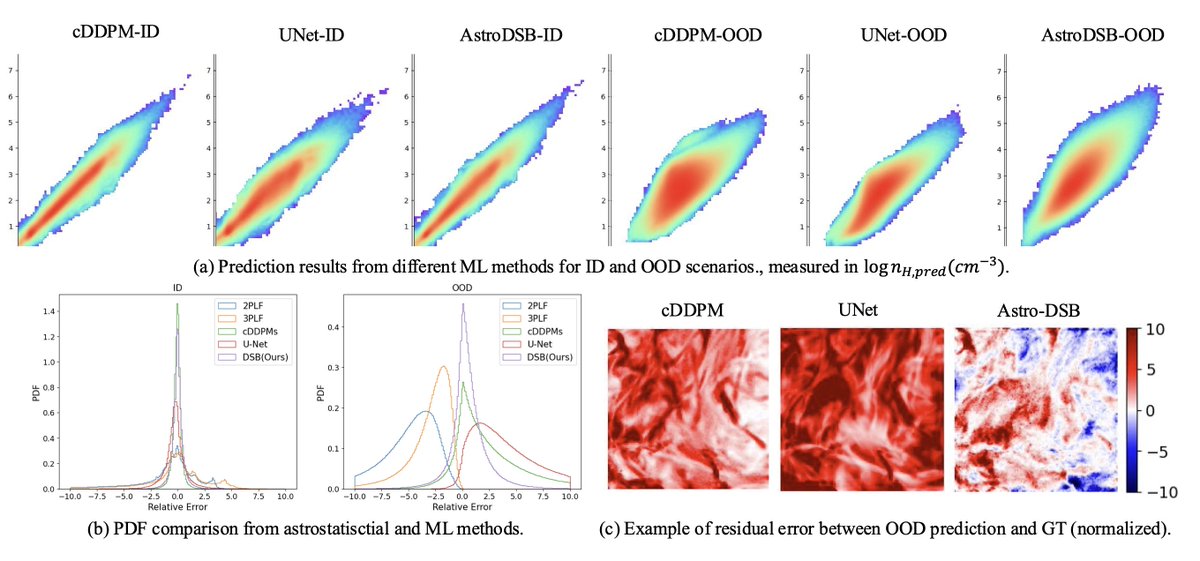
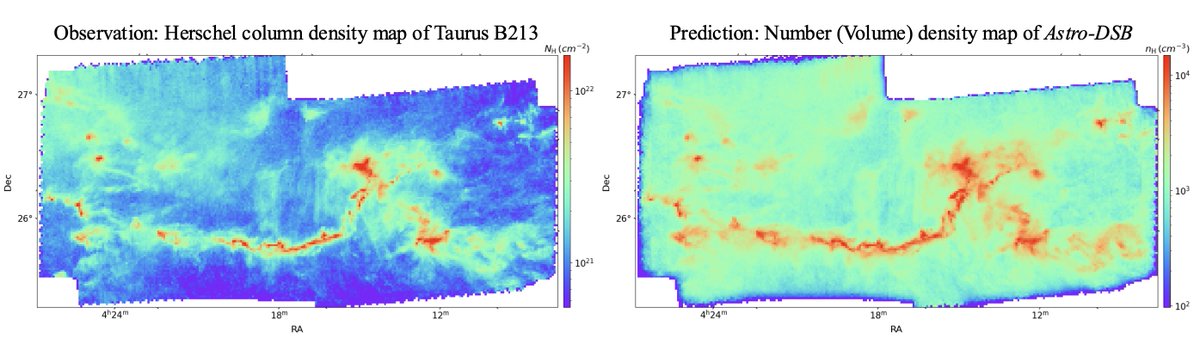
    Excited to share our NeurIPS 2025 paper Dynamic Diffusion Schrödinger Bridge in Astrophysical Observational Inversions! #neurips2025 #DiffusionModels #AstroML In this work, we introduce Astro-DSB, a novel diffusion bridge-based approach designed to tackle astrophysical inversion problems in the context of Giant Molecular Clouds (GMCs) for star formation. Our goal is to infer underlying physical states (e.g., density and magnetic fields) from projected, partial observations. We train Astro-DSB on both simulated density and magnetic field data, and test its in-distribution (ID) and out-of-distribution (OOD) performance on new simulations, as well as real observational data from Taurus B213. We show that Astro-DSB achieves substantially better OOD generalization than both traditional astrostatistical methods and state-of-the-art conditional diffusion models. It also reduces the required training time by 75% compared to cDDPMs. Paper and code are available! Check out at and
    Download
    67747.4K
  7. Monte Carlo Seminar@OnlineMCSeminar
    Join our next Monte Carlo seminar (Tue, Jan 20, 2026)! Speaker: Jiequn Han (Flatiron Institute) Talk: “DriftLite: Lightweight drift control for inference-time scaling of diffusion models” Time: 8:30am PT / 11:30am ET / 4:30pm London / 5:30pm Paris #DiffusionModels #MonteCarlo
    Download
    03203.2K
  8. Utkarsha@UtkarshaNerle
    How does AI turn pure static into a photo? 🌫️➡️🖼️ Diffusion models: 1⃣ Add noise to real data until only static is left 2⃣ Train a U-Net to predict that noise 3⃣ Start from noise, denoise step by step → new image #GenAI #DiffusionModels
    Download
    00123
  9. Minhyuk Sung✓@MinhyukSung
    #DiffusionModels Big thanks to @OPatashnik for the insightful guest lecture in our diffusion models course on using attention layers in diffusion networks for image manipulation. Don’t miss the recording! 🎥:
    011554.9K
  10. Yizhe Zhang@YizheZhangNLP
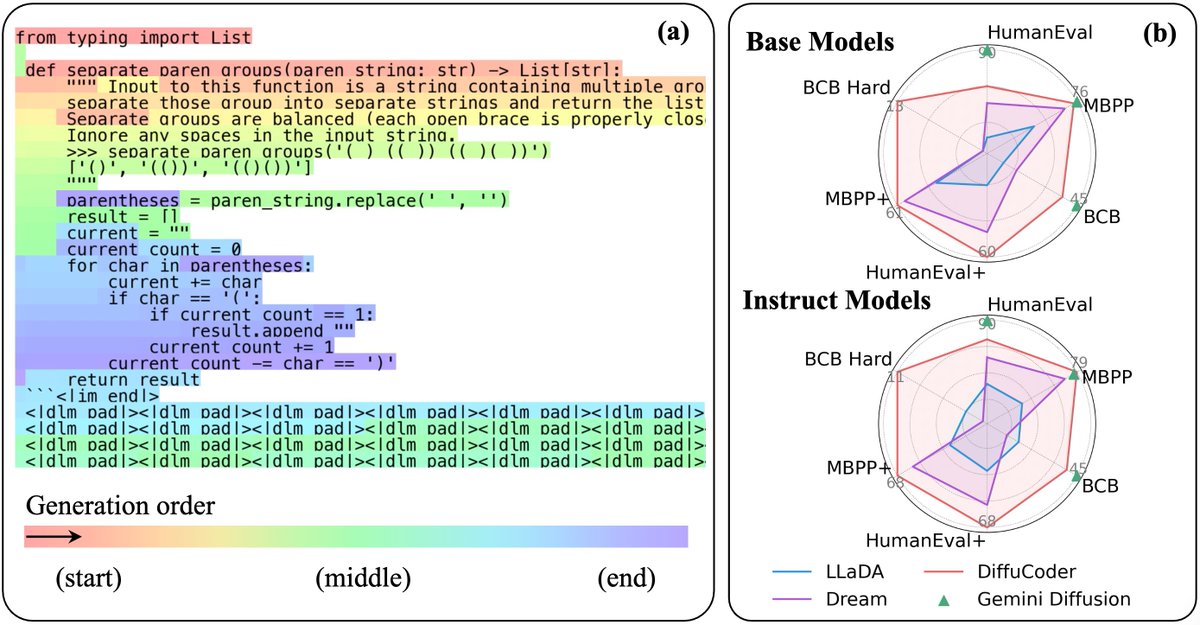
    Excited to introduce our 7B Coding Diffusion LLM, DiffuCoder — advancing open-source diffusion models for high-quality code generation! Diffusion offers powerful global planning via iterative generation, and code is the perfect testbed to push its limits! #DiffusionModels
    Sansa Gong @sansa19739319
    🤖Can diffusion models write code competitively? Excited to share our latest 7B coding diffusion LLM!!💻 With DiffuCoder, we explore how they decode, why temperature🔥 matters, and how to improve them via coupled-GRPO that speaks diffusion!!📈 Code: 🧵
    211675.4K
  11. Sansa Gong✓@sansa19739319
    🤖Can diffusion models write code competitively? Excited to share our latest 7B coding diffusion LLM!!💻 With DiffuCoder, we explore how they decode, why temperature🔥 matters, and how to improve them via coupled-GRPO that speaks diffusion!!📈 Code: 🧵
    Download
    511256949.6K
  12. Stephan Mandt✓@StephanMandt
    How can we speed up #DiffusionModels and find better model families? To this end, let's talk about "A Complete Recipe for Diffusion Generative Models" (#ICCV Oral). To this end, let's focus on the stochastic process that converts data to random noise (1/7). @kpandey008
    378318.4K
  13. Show more posts