Posts with #openscience

#openscience

Public posts on X that use #openscience.

Related hashtags

  1. nature✓@Nature
    Science funders and research organizations in Europe are joining forces to expand open-access publishing and make the peer-review process more transparent
    6238117.8K
  2. MTS@MTSlive
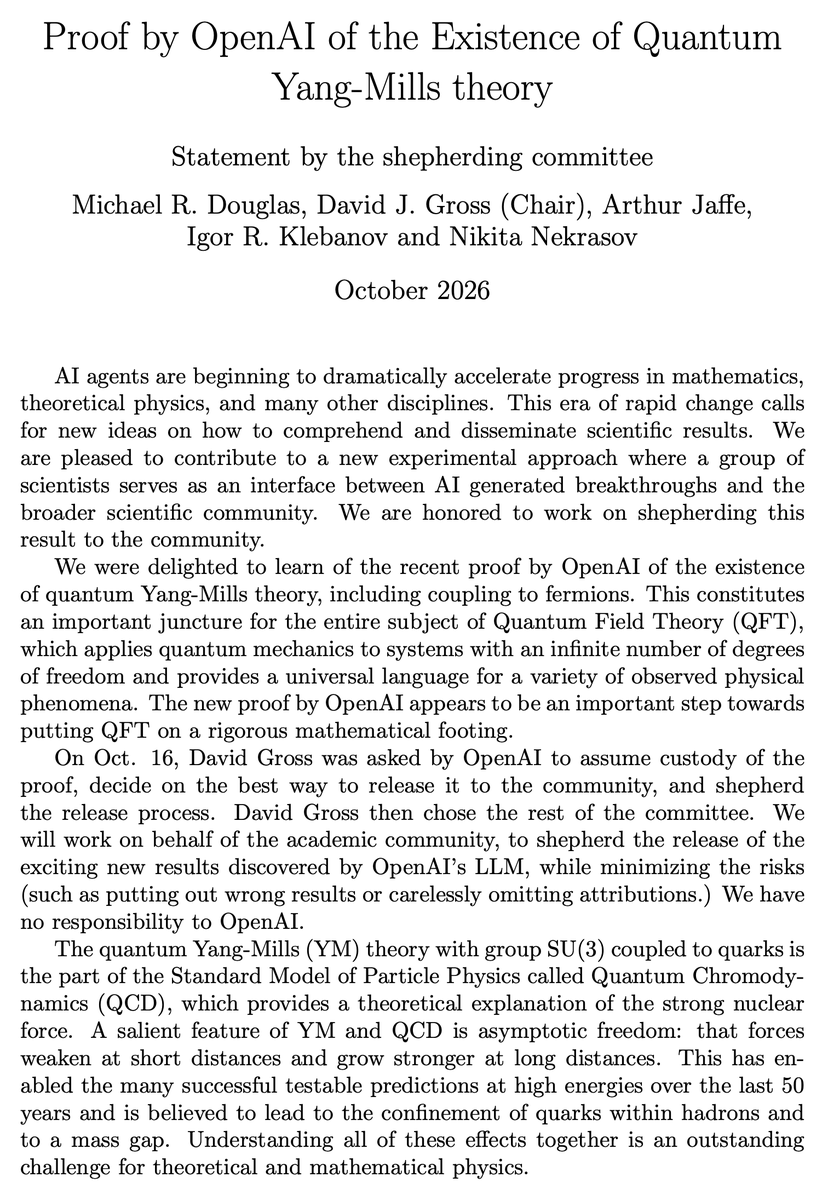
    SITUATION EXPLAINED: OpenAI says its AI cracked 3 major open problems in math, computer science, and physics at once. • The math result claims to prove "local smoothing" for waves in every dimension, which would settle the Kakeya, Stein restriction, and Bochner-Riesz conjectures together • That would turn Hong Wang's 3D Kakeya proof, which won a Fields Medal this year, into a special case • The CS result refutes the exponential time hypothesis, the belief that problems like 3-SAT always take exponential time • Hundreds of papers rely on that assumption, and OpenAI says the proof was checked in Lean • The physics result claims existence proofs for 4D Yang-Mills, QCD, and a grand unified theory, but not the mass gap needed for the $1M Millennium Prize • A group led by Nobel laureate David Gross is reviewing the physics proof, and its materials haven't been released • OpenAI says it won't seek academic credit for discoveries made by its internal models @theojaffee: "Don't defer to the experts on releasing materials. You can defer to them on how you should communicate your results, but I don't see any legitimate reason for academics to block the result of a major math or science thing just because they want to."
    Download
    Greg Brockman @gdb
    Announcing three major scientific discoveries, one each in mathematics (harmonic analysis), computer science (complexity theory), and physics (quantum field theory). AI starting to help us improve our understanding of the universe!
    34456.6K
  3. Greg Brockman✓@gdb
    Announcing three major scientific discoveries, one each in mathematics (harmonic analysis), computer science (complexity theory), and physics (quantum field theory). AI starting to help us improve our understanding of the universe!
    6822K16.2K3.2M
  4. allen institute@AllenInstitute
    Introducing the Allen Brain Cell (ABC) Atlas [ʙᴇᴛᴀ] representing ~5,200 newly transcriptomic-defined cell types and their spatial locations across the whole mouse brain. 🧵 Access ABC Atlas data visualization & pre-publication #openscience datasets:
    Download
    2309898199K
  5. SAIR✓@SAIRfoundation
    More than 300 research teams have been approved and are using Open Math OS. We recommend applying with your research institution email so we can easily verify your affiliation. We’re scaling up to serve the math and science community. Apply now:
    57674.4K
  6. Kavli Institute for Theoretical Physics@KITP_UCSB
    Statement of Yang-Mills Working Group, a scientific collaboration to interpret AI result related to the existence of quantum chromodynamics & completions of the Standard Model, including a subproblem proving the existence of the Quantum Yang-Mills theory.
    Download
    752341.2K342K
  7. Francesco Maggi✓@Frances01896069
    @KITP_UCSB
    Your group can work on these documents, develop rigorous expositions, and organize whatever scientific activities it considers useful without making the original material inaccessible to other researchers. I think this decision is deeply at odds with the principle of open science. Once a public claim of a major scientific discovery is made, the evidence supporting that claim should be made public, even if it still requires independent verification. The current arrangement facilitates a public claim of priority while granting only a selected group access to the purported proof. This is very difficult to reconcile with the principles of openness and independent scrutiny on which modern science rests. Please reconsider. Your group can carry out its work without withholding the material from the scientific community.
    2101639.3K
  8. Foresight Institute✓@foresightinst
    Four days left to apply for our Request for Proposals. Up to $100K in grant funding, office space in SF and Berlin, community, and compute for open AI for science and safety projects. Three calls: • Local Compute • Coordination and Accountability • AI-first Science: Bio, Neuro, Nano Deadline: Oct 31. Apply: Links to each open call in thread.
    Download
    22417512.2K
  9. C. Michael Gibson MD✓@CMichaelGibson
    Preprint-centric publishing model gets major boost Science funders and research organizations in Europe are joining forces to expand open-access publishing and make the peer-review process more transparent, with the aim of spurring change in scholarly communication. By early November, the European Commission will roll out an expanded version of its Open Research Europe (#ORE) platform, which uses a ‘publish, review, curate’ model. In this approach, preprints are posted, reviewed openly — with the identity of the reviewers and their reports made public — then flagged as ‘peer reviewed’ on the same platform.
    24242.7K
  10. Emma Scharfman✓@EmmaScharfmann
    So much happened in AI for Science on the 🤗 Hub this month! I summarized what these new models and datasets are about, to make them accessible to anyone curious about AI for Science 🚀
    9258815.8K
  11. Feller .COMMS OPEN!@Feller0__0
    They found the Aperture Science testing facility?
    New York Post @nypost
    Massive salt mine 2,000 feet under Lake Erie forced to shut down for terrifying reason
    0010358
  12. New York Post✓@nypost
    Massive salt mine 2,000 feet under Lake Erie forced to shut down for terrifying reason
    Download
    1851380256K
  13. Preprints.org@Preprints_org
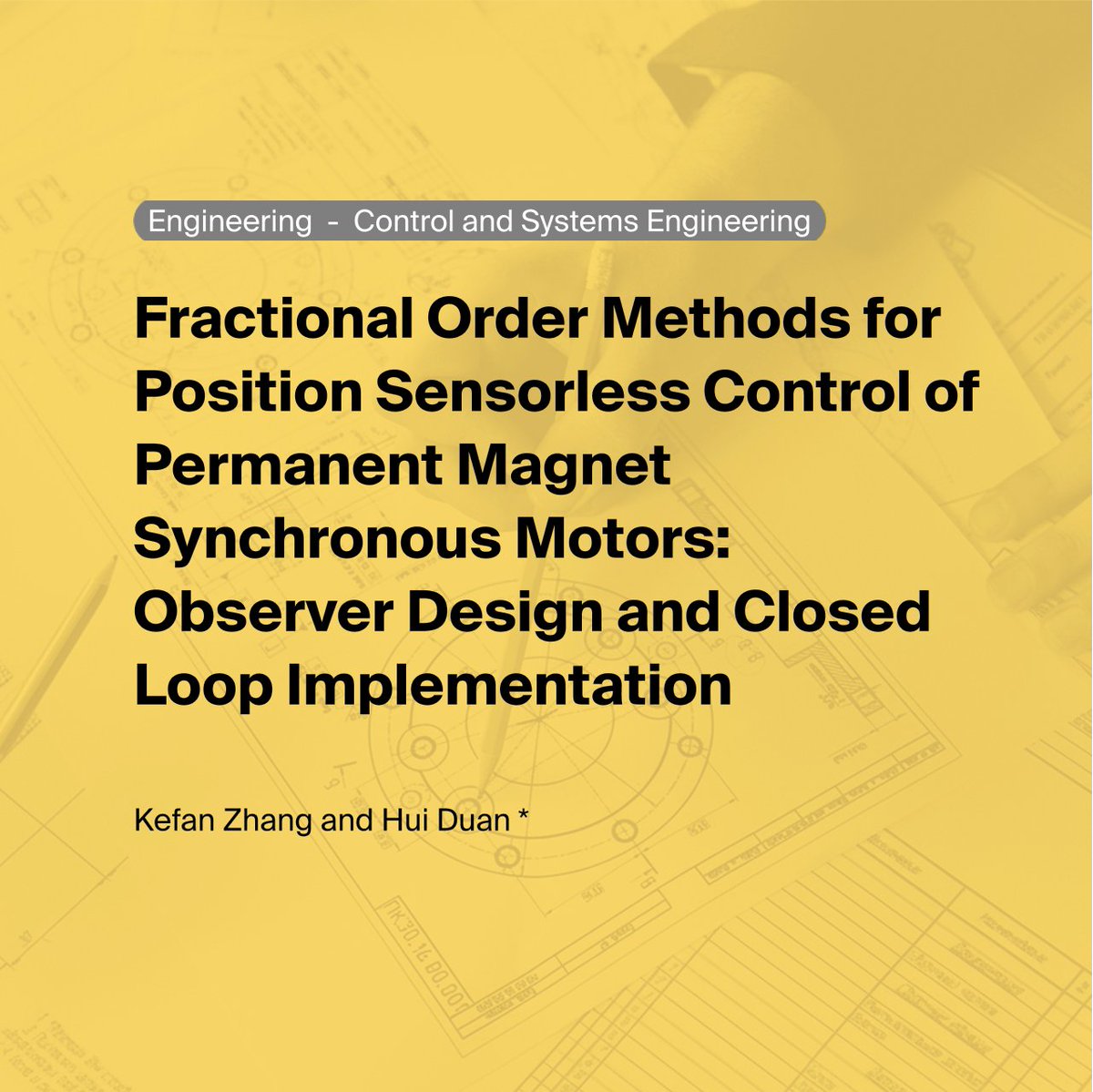
    A #preprint combines the operating characteristics of position sensorless permanent magnet synchronous motor drives and summarizes the application of fractional order methods in this field. 👇 Link in the comments. #OpenScience
    Download
    115158
  14. allen institute@AllenInstitute
    Our Institute for Brain Science recently released the first dataset from live human neurons. This #openscience resource contains electrophysiological, morphological, and transcriptomic properties gathered from individual cells, and models simulating cell activity. #BrainWeek
    Download
    6237437
  15. allen institute@AllenInstitute
    The most detailed version yet - Researchers can freely access the Allen Mouse Brain Common Coordinate Framework (v3), a complete, high-resolution 3D atlas of the mouse brain. #openscience #neuroscience Read:
    Download
    6139552
  16. Luis✓@luismeta
    The headline everyone’s quoting is the discoveries. The part I’d actually watch is the review. A model proposes something hard, outside experts check it in the open, and everyone gets to see the receipts l, not a private “trust us” thread. What’s interesting is the shape of the loop: propose -> adversarial check -> public result That’s how you earn trust in a finding nobody can verify alone from a chat screenshot. You’d plug this mindset into any agent pipeline where the output has to survive a second set of eyes before you ship it, research, security, science, even product claims. The discoveries are cool. The open review is the product.
    Greg Brockman @gdb
    Announcing three major scientific discoveries, one each in mathematics (harmonic analysis), computer science (complexity theory), and physics (quantum field theory). AI starting to help us improve our understanding of the universe!
    2313173
  17. Shining Science✓@ShiningScience
    OpenAI's new memory system turns your past chats into a profile of you that updates itself in the background. Here’s how to stop it. OpenAI has upgraded ChatGPT's memory with a system it calls "dreaming." In the background, ChatGPT reviews your past conversations and writes a summary of you, organized by parts of your life, such as your work and projects, hobbies, travel plans, where you live and how you like answers. It keeps the profile current, so a trip you were planning becomes a trip you took. The upgrade went first to Plus and Pro users in the US, with Free and Go users and other countries to follow. Separately, researchers who studied 2,050 memories from 80 real ChatGPT users found that 96% were created by the chatbot on its own, 28% contained personal data as defined by Europe's privacy law, and 52% held psychological insights about the user. OpenAI says this makes ChatGPT more helpful because you don't have to repeat yourself. But it also means a lot of what the chatbot knows about you was decided by the chatbot, not you. You can check it: go to Settings > Personalization > Memory to open your memory summary, where you can correct or delete individual details, or ask ChatGPT what it remembers about you. The ••• menu in the summary has "Delete and turn off memory," and you can also switch off "Reference chat history" there. Deleting a memory doesn't delete the chat it came from, so delete that chat too. Temporary chats don't create memories. The study is a preprint that hasn't been peer reviewed. sources: OpenAI. (2026). Dreaming: Better memory for a more helpful ChatGPT. OpenAI. Dash, A., Das, S., Kirsten, E., Wu, Q., Karnam, S. K., Gummadi, K. P., Holz, T., Zafar, M. B., & Zannettou, S. (2026). The algorithmic self-portrait: Deconstructing memory in ChatGPT. arXiv.
    Download
    116614.6K
  18. AI at Meta✓@AIatMeta
    Today we're announcing support for university research at @Caltech, @OhioStateMed, @LSU, @IndianaUniv, and @UTHealthHouston to help advance breakthroughs across science and medicine. As part of the support for university researchers, we’ll provide access to our latest Muse models, including Muse Wonder and Muse Spark; open weight models like Muse Glimmer and Muse Spark Open; computer vision models such as SAM, V-JEPA, and DINO; as well as SeamlessM4T, our multilingual communication model. We’re excited to support these five universities as they use our models to accelerate the important work they’re doing. Read more on our research blog:
    Download
    433422042K
  19. Parv Mahajan✓@parvmahajan0
    In general, many interp and alignment results might not hold up on current frontier architectures, and researchers should be pushing for more transparency from labs to allow for open science.
    Thomas Jiralerspong @tomjiralerspong
    PSA to everyone doing neuron interp after the recent monosemantic neuron posts: the model's training recipe matters a lot. e.g. GPT2 seems to have been trained WITH dropout (modern LLMs are not), which seems to increase redundancy and (maybe) polysemanticity but reduce superposition (see sources in comments). Other choices probably also have an effect (e.g. SwiGLU vs GELU MLPs, optimizer, amount of weight decay, etc.) and I think we should be careful not to generalize too much. Currently working on a project to characterize the effects of these choices on neuron interpretability (a lot of the existing work is done on older/toy models which I'm not sure are representative), feel free to reach out if interested!
    29983.2K
  20. Thomas Jiralerspong✓@tomjiralerspong
    PSA to everyone doing neuron interp after the recent monosemantic neuron posts: the model's training recipe matters a lot. e.g. GPT2 seems to have been trained WITH dropout (modern LLMs are not), which seems to increase redundancy and (maybe) polysemanticity but reduce superposition (see sources in comments). Other choices probably also have an effect (e.g. SwiGLU vs GELU MLPs, optimizer, amount of weight decay, etc.) and I think we should be careful not to generalize too much. Currently working on a project to characterize the effects of these choices on neuron interpretability (a lot of the existing work is done on older/toy models which I'm not sure are representative), feel free to reach out if interested!
    233670935.8K
  21. Scripps Institution of Oceanography@Scripps_Ocean
    🌊 Applications are open for Fall 2027 Scripps Oceanography programs! ⚠️ Application deadlines: ▶️ Undergraduate programs: Nov. 30, 2026 ▶️ Master of Science programs: Dec. 2, 2026 ▶️ Doctoral programs: Dec. 2, 2026 Learn more:
    Download
    137999
  22. Show more posts