Posts with #quantumerrorcorrection

#quantumerrorcorrection

Public posts on X that use #quantumerrorcorrection.

Related hashtags

  1. Jens Eisert✓@jenseisert
    One of the core challenges in realizing scalable quantum computing is achieving fault tolerance. In this recent talk, I share some perspectives on #quantumerrorcorrection and #faulttolerance, including insights into new #qLDPC codes tailored to physical architectures and allowing for relatively cheap and parallelizable quantum logic. I gave this talk at the wonderful #FTQC4NSc symposium on "Fault-Tolerant #QuantumComputing for the Natural Sciences" held at experimenta – Das Science Center in Heilbronn. The scientific work at the heart of the talk has been done with Boren Gu, Andy Liu, Armanda Quintavalle, Qian Xu, Joschka Roffe, Tamás Noszkó, Vincent Steffan, Jens Niklas Eberhardt, and Stergios Koutsioumpas. The recording is now out.
    Download
    110421.9K
  2. Jens Eisert✓@jenseisert
    Fermionic quantum error correction is never free #Quantumerrorcorrection for fermions comes at an intrinsic price: non-#Gaussianity. In our new work, we prove that any non-trivial fermionic quantum error-correcting code necessarily goes beyond free-fermion, quadratic dynamics. Indeed, its logical space cannot contain even a single pure fermionic Gaussian state—a fundamental incompatibility between error correction and Wick’s theorem. Moreover, the number of bounded-weight non-Gaussian gates needed to prepare codewords grows at least linearly with both code distance and the number of encoded modes. This reveals a fundamental resource challenge for scalable fermionic quantum computing, from #Majorana platforms to cold atoms—and a striking contrast with qubit error correction, where classically simulable #stabilizer operations provide the standard framework. Warm thanks to @YifanTang1999, Ingo Roth, @phfaist, Zi Wen Liu, and @ZhenhuanLiu for this wonderful collaboration.
    Download
    516762.6K
  3. Jens Eisert✓@jenseisert
    Dynamical codes for hardware with noisy readouts We deliver good design choices for measurement schedules for dynamical codes in #quantumerrorcorrection in the presence of noisy measurements. And define the "teraquop volume" as a new metric. In detail, #dynamical stabilizer codes may offer a practical route to large-scale #quantumcomputation. Such codes are defined by a schedule of error-detecting measurements, which allows for flexibility in their construction. In this work, we ask how best to optimise the measurement schedule of dynamically condensed colour codes in various limits of noise bias. We take a particular focus on the setting where measurements introduce more noise than unitary and idling operations - a noise model relevant to some hardware proposals. For measurement-biased noise models, we improve code performance by strategically repeating measurements within the schedule. For unbiased or Z-biased noise models, we find repeating measurements offers little improvement - somewhat contrary to our expectations - and investigate why this is. To perform this analysis, we generalise a metric called the teraquop footprint to the #teraquopvolume. This is the product of the number of qubits and number of rounds of measurements required such that the probability of a spacelike or timelike logical error occurring is less than 10−12. In most cases, we find differences in performance are primarily due to the number of rounds of measurements required, rather than the number of qubits - emphasising the importance of using the teraquop volume in the analysis. Additionally, our results provide another example of the importance of making use of correlated errors when decoding, in that using belief matching rather than minimum-weight perfect matching can turn a worst-performing code under a given noise model into a best-performing code. Warm thanks to @PeterJanDerks1, Alex Townsend-Teague, Markus Kesselring, @oscarhiggott, and Benjamin Brown for the collaboration.
    Download
    58315.3K
  4. Jens Eisert✓@jenseisert
    Wonderful talks on #quantumerrorcorrection by friends of the family @timohillmann and Georgia Nixon this week, specifically on “stroboscopic stabilization of cat qubits” and “vine codes: low-overhead quantum LDPC codes in a planar square grid”.
    Download
    01371.9K
  5. Jens Eisert✓@jenseisert
    Codesign in #quantumerrorcorrection usually refers to combining physical desiderata with those of codes. Here we suggest to codesign decoders and codes. Native Gottesman–Kitaev–Preskill (#GKP) codes offer a remarkably rich way of encoding quantum information into bosonic modes—but constructing good codes and decoding them efficiently are generally hard problems. We turn this logic around: What if the requirement of efficient decoding determines the code? Building on classical low-density lattice codes, we introduce quantum GKP-LDLCs: #lattice-based GKP codes designed with efficient message-passing decoding in mind. After suitable dimensional reduction, they achieve code properties comparable to, or better than, concatenated GKP–surface codes using the same number of modes. We also study fully analog message-passing decoders for concatenated GKP-#LDPC codes. These decoders run in linear time while performing close to state-of-the-art hybrid qubit–analog approaches. The broader message is simple: do not first construct a code and only then worry about decoding it. Let efficient decoding shape the code from the outset. Warm thanks to @timohillmann and @Frarzani for this wonderful collaboration.
    Download
    07492.4K
  6. NVIDIA HPC Developer✓@NVIDIAHPCDev
    Real-time decoding is the key challenge facing #quantumerrorcorrection, and now it can be performed with the latest release of NVIDIA CUDA-Q QEC. 🛠️⚛️ #QPU builders and researchers can now run AI and GPU-accelerated decoders for both real and simulated QPUs, scaling #quantum hardware into useful quantum-GPU supercomputers. Read the full technical deep dive:
    Download
    24251.4K
  7. Jens Eisert✓@jenseisert
    Experimental measurement and a physical interpretation of quantum shadow enumerators We show that Rains' quantum shadow enumerators - a powerful mathematical tool in the theory of #quantumerrorcorrection - admit a direct physical interpretation in terms of outcome statistics of two-copy Bell measurements. This connection enables efficient #learning protocols for these quantities and is demonstrated experimentally on a trapped-ion quantum device. Happy to see this paper out. Warm thanks to @dm28295 who has been in the driver's seat here, the local team of @SumeetKhatri6, @lorenzo_leone_ , @QuAntonioMele, Kyano Levi, Lennart Bittel, Gregory White, Yifan Tang, Eric J. Kuehnke, Jose Carrasco, and our friends at the Universität Innsbruck under the lead of Thomas Monz and @MartinRingbauer, for making this joint theoretical-experimental work possible.
    Download
    17763.3K
  8. Jens Eisert✓@jenseisert
    As a community, we need to identify codes for #quantumerrorcorrection that respect desiderata arising from a physical context. Here we introduce the domain wall color code.
    Download
    2168814.6K
  9. Jens Eisert✓@jenseisert
    Chasing shadows with Gottesman-Kitaev-Preskill codes We explore a research question at the intersection of #quantumerrorcorrection and #quantumlearningtheory. Concretely, we consider the task of performing shadow tomography of a logical subsystem defined via the Gottesman-Kitaev-Preskill (#GKP) error correcting code. Our protocol does not require the input state to be a code state but is implemented by appropriate twirling of the measurement channel, such that the encoded logical tomographic information becomes encoded in the classical shadow. We showcase this protocol for measurements natural in #continuousvariable(CV) quantum computing. For heterodyne measurement, the protocol yields a probabilistic decomposition of any input state into Gaussian states that simulate the encoded logical information of the input relative to a fixed GKP code where we prove bounds on the Gaussian compressibility of states in this setting. For photon parity measurements, our protocol is equivalent to a Wigner sampling protocol for which we develop the appropriate sampling strategies. Finally, by randomizing over the reference GKP code, we show how Wigner samples of any input state relative to a random GKP codes can be used to estimate any sufficiently bounded observable. Warm thanks to Jonathan Conrad and @S_Flammia for the wonderful collaboration.
    Download
    37382.2K
  10. Jens Eisert✓@jenseisert
    Hardware-tailored logical Clifford circuits for stabilizer codes It is becoming increasingly important to identify clever strategies for implementing Clifford unitaries at the logical level of a given stabilizer code in #quantumerrorcorrection, while respecting hardware constraints. Here is one such strategy.
    Download
    213462.7K
  11. Qodesign@qodesign
    #QuantumErrorCorrection Another nice example of ("heptagon") holographic code : with comparison to more familiar pentagonal one. This one has lower rate : 1/7,8/42,43/203,211/973,...,1/sqrt(21) it's half the rate; so unsurprisingly performs better.
    002
  12. Jens Eisert✓@jenseisert
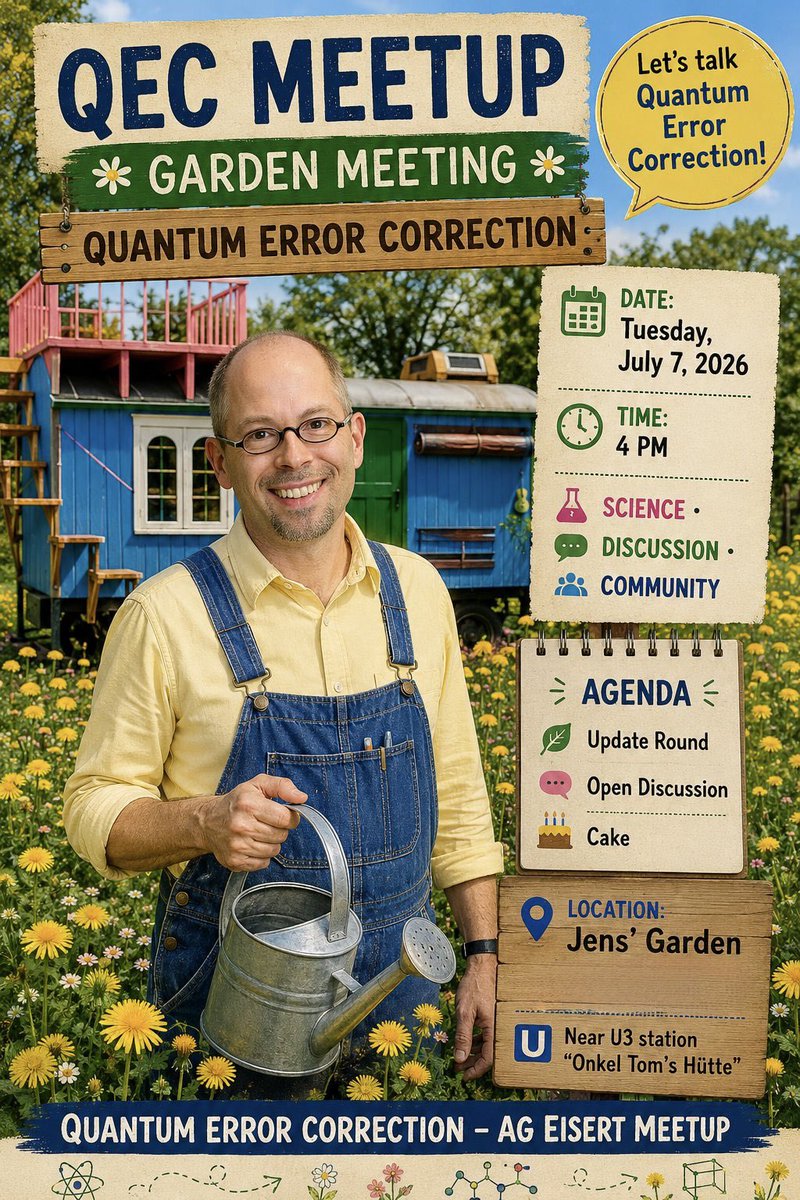
    A great student just sends me this advertisement of our next garden meeting on #quantumerrorcorrection. I had to laugh. This helps me overcome the sadness of not attending #QEC2026. At which our wonderful Boren Gu will speak later today.
    Download
    10341.4K
  13. Show more posts