itszn

@itszn13

Amy | Security researcher @ OpenAI | https://t.co/W1SE7NmCx8 | bsky: https://t.co/JBmOGE4YKO | LLM ART: https://t.co/7FtQ8O8nAW

752 Following12.4K Followers1.4K Posts
  1. itszn@itszn13
    php2shell is the most consequential vulnerability I have ever helped discover. I am proud of how our team worked closely in coordination with the PHP Foundation to provide support and to harden the patch in preparation for this release.

Please read more about our approach:
    Download
    OpenAI @OpenAI
    OpenAI models helped researchers—operating as part of our Patch the Planet initiative—discover critical security flaws in PHP, an open-source programming language used to run an estimated 70% of websites. Over the past two months, we led a coalition of maintainers, researchers, and security providers to prepare fixes and protections ahead of disclosure. This duration was necessary because the fix was quite intricate and required a major change to the PHP engine. Every site using PHP can now safely upgrade their version to stay secure, in addition to applying mitigations from various security vendors. Due to the severity of these flaws and PHP’s widespread use, we consider this bug to be one of the most impactful vulnerabilities in recent memory. It also marks a new phase, where AI can find security bugs with internet-scale impact. This is an example of the Defender’s Window in action: to our knowledge, frontier AI was able to find this vulnerability ahead of attackers, giving defenders time to prepare.
    451541.4K109K
  2. OpenAI✓@OpenAI
    OpenAI models helped researchers—operating as part of our Patch the Planet initiative—discover critical security flaws in PHP, an open-source programming language used to run an estimated 70% of websites. Over the past two months, we led a coalition of maintainers, researchers, and security providers to prepare fixes and protections ahead of disclosure. This duration was necessary because the fix was quite intricate and required a major change to the PHP engine. Every site using PHP can now safely upgrade their version to stay secure, in addition to applying mitigations from various security vendors. Due to the severity of these flaws and PHP’s widespread use, we consider this bug to be one of the most impactful vulnerabilities in recent memory. It also marks a new phase, where AI can find security bugs with internet-scale impact. This is an example of the Defender’s Window in action: to our knowledge, frontier AI was able to find this vulnerability ahead of attackers, giving defenders time to prepare.
    6242.9K14.5K5.9M
  3. itszn@itszn13
    itszn
    RT @ky1ebot: Sandboxing is really hard especially when facing our cyber capable models. So, we used our cyber capable model to red-team our own sandbox stack and found issues in many layers of the stack, including but not limited to Kata, gVisor, docker, and Linux.
    OpenAI @OpenAI
    Over the past several months, we have substantially hardened the security of our research training environment. We’ve removed live internet access for all frontier models during training and built an offline world for them to use instead—a cached version of the web where they can still learn to browse, search, and use applications. On September 20, after a model exploited a DNS misconfiguration to find a way outside of this offline world, we paused frontier training to strengthen containment further. We assembled teams of agents, powered by our most cyber-capable models, and tasked them with finding weaknesses in our research environments. While they found no route to the internet they could easily exploit while concealing their activity from our monitors, they did find zero-day vulnerabilities, virtual machine escapes, and hardware side-channels for communication between agents. We used their discoveries to further strengthen our defenses and contribute fixes to open-source software. After strengthening our containment architecture, we resumed our frontier RL training and inference on October 1. We’ve reserved substantial compute for continuous red-teaming, and made high-compute red-teaming part of the safety cases we use to decide whether frontier training and evaluation can proceed securely.
    015061
  4. OpenAI✓@OpenAI
    Over the past several months, we have substantially hardened the security of our research training environment. We’ve removed live internet access for all frontier models during training and built an offline world for them to use instead—a cached version of the web where they can still learn to browse, search, and use applications. On September 20, after a model exploited a DNS misconfiguration to find a way outside of this offline world, we paused frontier training to strengthen containment further. We assembled teams of agents, powered by our most cyber-capable models, and tasked them with finding weaknesses in our research environments. While they found no route to the internet they could easily exploit while concealing their activity from our monitors, they did find zero-day vulnerabilities, virtual machine escapes, and hardware side-channels for communication between agents. We used their discoveries to further strengthen our defenses and contribute fixes to open-source software. After strengthening our containment architecture, we resumed our frontier RL training and inference on October 1. We’ve reserved substantial compute for continuous red-teaming, and made high-compute red-teaming part of the safety cases we use to decide whether frontier training and evaluation can proceed securely.
    1.2K1.2K13.7K7.6M
  5. itszn@itszn13
    The critical Brotli RCE vulnerability discovery came out of our large scale infrastructure code scanning efforts Great research by @k_tr4n and @_sy1vi3 in assessing the widespread impact of this bug Update your Node.js, Bun, Envoy, anything using Brotli ASAP!
    Download
    OpenAI @OpenAI
    During this red-teaming exercise, we also found a vulnerability that allows for unauthenticated remote code execution in Brotli, a widely-deployed compression library included in many pieces of software such as Node.js, Bun, and Envoy. The flaw could let an attacker run their own code on affected systems by sending or replying with malicious compressed data, without any need to create a user account. That is, an unpatched server that accepts compressed input could be taken over by a malicious client, and an unpatched client that accepts compressed input (such as “curl --compressed”) could be taken over by a malicious server. This root cause issue was actually fixed in the Brotli source code in February, but it wasn’t known at the time that it gave rise to a security vulnerability and there was no more recent release of Brotli. Since Brotli is built into other software, any software which includes this library needs to take the update too, followed by the users of that software. We disclosed the vulnerability to Brotli and other downstream projects such as Node.js, which released or are currently releasing security updates, and Brotli cut new release versions and published a CVE. More details on the patch and mitigations below:
    63317519.2K
  6. OpenAI✓@OpenAI
    During this red-teaming exercise, we also found a vulnerability that allows for unauthenticated remote code execution in Brotli, a widely-deployed compression library included in many pieces of software such as Node.js, Bun, and Envoy. The flaw could let an attacker run their own code on affected systems by sending or replying with malicious compressed data, without any need to create a user account. That is, an unpatched server that accepts compressed input could be taken over by a malicious client, and an unpatched client that accepts compressed input (such as “curl --compressed”) could be taken over by a malicious server. This root cause issue was actually fixed in the Brotli source code in February, but it wasn’t known at the time that it gave rise to a security vulnerability and there was no more recent release of Brotli. Since Brotli is built into other software, any software which includes this library needs to take the update too, followed by the users of that software. We disclosed the vulnerability to Brotli and other downstream projects such as Node.js, which released or are currently releasing security updates, and Brotli cut new release versions and published a CVE. More details on the patch and mitigations below:
    OpenAI @OpenAI
    Over the past several months, we have substantially hardened the security of our research training environment. We’ve removed live internet access for all frontier models during training and built an offline world for them to use instead—a cached version of the web where they can still learn to browse, search, and use applications. On September 20, after a model exploited a DNS misconfiguration to find a way outside of this offline world, we paused frontier training to strengthen containment further. We assembled teams of agents, powered by our most cyber-capable models, and tasked them with finding weaknesses in our research environments. While they found no route to the internet they could easily exploit while concealing their activity from our monitors, they did find zero-day vulnerabilities, virtual machine escapes, and hardware side-channels for communication between agents. We used their discoveries to further strengthen our defenses and contribute fixes to open-source software. After strengthening our containment architecture, we resumed our frontier RL training and inference on October 1. We’ve reserved substantial compute for continuous red-teaming, and made high-compute red-teaming part of the safety cases we use to decide whether frontier training and evaluation can proceed securely.
    5531K7.1K2.1M
  7. itszn@itszn13
    itszn
    RT @lcfr_hax: Team work makes the dream work <3 We wanted to do something a bit different than using LLM's to generate all the pieces from exploit, writeup and art. We decided on a human created comic to offset the LLM usage in our release, that tells the tale with some exaggerated scenarios inspired from a few movies. If you liked the art (or want your own exploit story/comic..) check out her work at
    Calif @calif_io
    Do you know who illustrated the comic on Her name is Stephanie Cortes. And her husband is the hacker who discovered php2shell: @lcfr_hax. This artist-hacker couple has the best story, stay tuned!
    035067
  8. Calif✓@calif_io
    Do you know who illustrated the comic on Her name is Stephanie Cortes. And her husband is the hacker who discovered php2shell: @lcfr_hax. This artist-hacker couple has the best story, stay tuned!
    301401.2K139K
  9. itszn@itszn13
    itszn
    RT @itszn13: Largest credit goes to @lcfr_hax for the earliest recent discovery of the bug class. This underlying engine issue was so wide it invited a lot of parallel discovery. As we coordinated our findings the scope of the problem continued to expand!
    014016.8K
  10. itszn@itszn13
    itszn
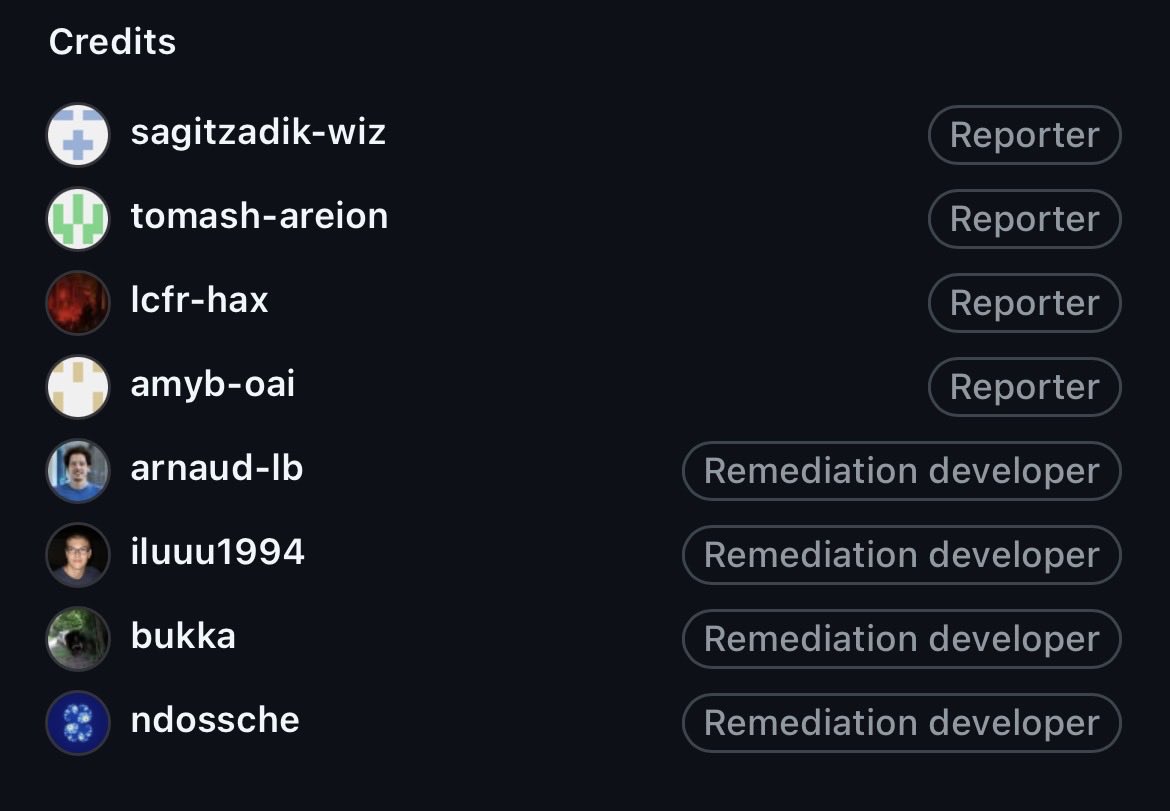
    RT @calif_io: Let’s set the record straight: @lcfr_hax was the first to discover php2shell and develop a working exploit. See his August 5 tweet: His work convinced the PHP Foundation to invest in fixing this entire bug class. He then worked around the clock to review, test, and retest the patches.
    LCFR @lcfr_hax
    d935be023a55b04681eccd1d2b8385b4b295e141a5df108e5e979d8d5d7124ac
    0408067
  11. LCFR✓@lcfr_hax
    d935be023a55b04681eccd1d2b8385b4b295e141a5df108e5e979d8d5d7124ac
    491121.4K673K
  12. itszn@itszn13
    When testing Astra on ExploitBench we found that it was able to achieve 100% ACE on all 41 CVEs So we made a contamination free internal port using only V8 CVEs from the past 3 months. Astra still showed a major capability increase over 5.6 and did so with a lot fewer tokens!
    Download
    OpenAI @OpenAI
    As we prepare to release Astra, we’re focused on making increasingly capable AI safe and broadly accessible. Astra represents a significant advance in cybersecurity capability, reaching the Critical threshold under our Preparedness Framework. We're previewing how we evaluated the model, how its safeguards have advanced alongside its capabilities, and what we'll continue to learn and improve.
    123537341K
  13. OpenAI✓@OpenAI
    As we prepare to release Astra, we’re focused on making increasingly capable AI safe and broadly accessible. Astra represents a significant advance in cybersecurity capability, reaching the Critical threshold under our Preparedness Framework. We're previewing how we evaluated the model, how its safeguards have advanced alongside its capabilities, and what we'll continue to learn and improve.
    9851.1K13.4K3.2M
  14. itszn@itszn13
    itszn
    RT @fouadmatin: Astra is both significantly more capable and more token efficient compared to 5.6 Sol, as seen in port of ExploitBench. We plan to make Astra available soon, with its most advanced cybersecurity capabilities initially more limited, then iteratively expand access more broadly.
    OpenAI @OpenAI
    As we prepare to release Astra, we’re focused on making increasingly capable AI safe and broadly accessible. Astra represents a significant advance in cybersecurity capability, reaching the Critical threshold under our Preparedness Framework. We're previewing how we evaluated the model, how its safeguards have advanced alongside its capabilities, and what we'll continue to learn and improve.
    068074
  15. itszn@itszn13
    Apple finally released a good chunk of my WebKit bugs! Good idea to update your Safari…
    Download
    132235521.9K
  16. itszn@itszn13
    Posts @itszn13
    These were found with a systematic effort using gpt-5.6-sol supplied with expert browser hacker knowledge and custom multi-agent harnesses Each bug is proven to get a minimum of arbitrary read/write (excluding a PAC bypass)
    13452.7K
  17. itszn@itszn13
    itszn
    RT @OpenAI: We've used GPT-5.6-Cyber extensively in real-world vulnerability research, including work that uncovered previously unknown vulnerabilities in popular open-source software like Chrome’s v8 engine.
    019066
  18. itszn@itszn13
    itszn
    RT @halvarflake: I have a personal update: Next monday, I will be starting at @OpenAI working on better cyber (which will also entail some efficiency work). I'm pretty excited about the things I will learn and the things we will do.
    059059
  19. itszn@itszn13
    Our research team (with the help of their agents) did it again! Second v8ctf in flag one week! Entirely separate 0day ARW bug and new 0day heap sandbox escape
    Download
    itszn @itszn13
    A team effort between me and gpt-5.6-sol, we finally checked off v8ctf from my bucket list with a 0day ARW and a 0day heap sandbox escape :)
    31023718.2K
  20. itszn@itszn13
    A team effort between me and gpt-5.6-sol, we finally checked off v8ctf from my bucket list with a 0day ARW and a 0day heap sandbox escape :)
    Download
    71630933.5K
  21. itszn@itszn13
    itszn
    RT @mahal0z: We are approaching perfect binary decompilation, and, crazier still, LLMs may soon be the best decompilers on the planet. I'd like to introduce DecBench, an evaluation site to determine how close we are to completing the field of perfect decompilation. Links and more in 🧵
    0134054
  22. itszn@itszn13
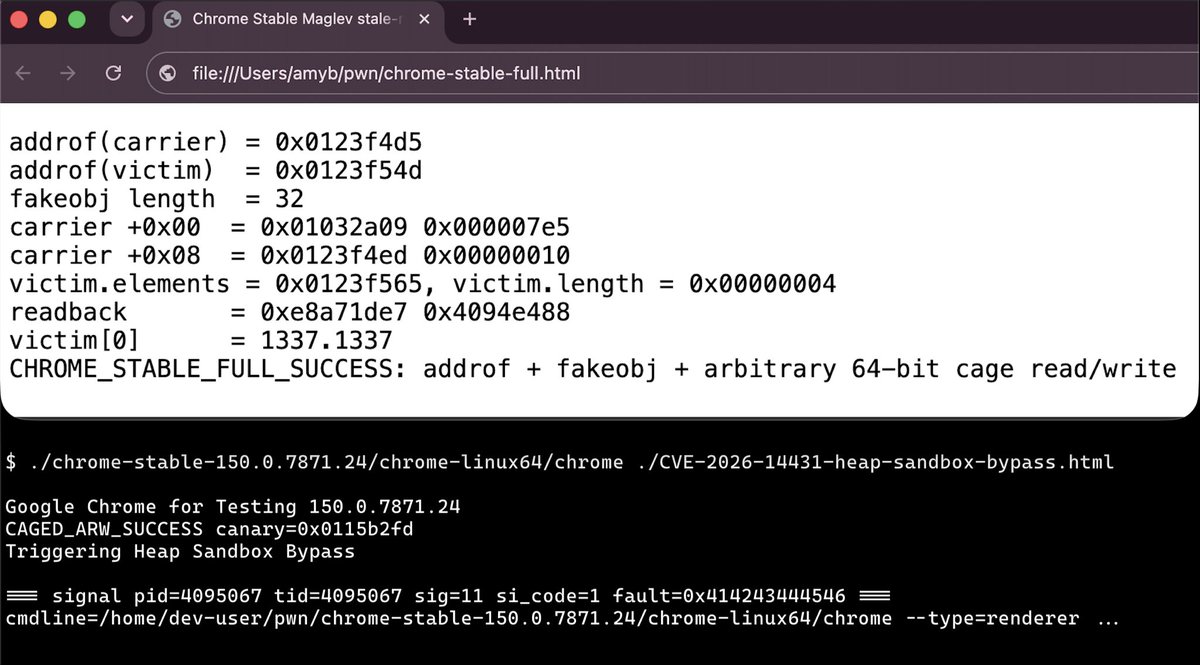
    We found another exploitable V8 JIT bug CVE-2026-14431; fixed in the most recent Chrome update This one was an interesting case of sloppy mode breaking JIT assumptions In addition the same session was able to find a working v8 heap sandbox bypass (although it ended up as a dup)
    Download
    62829024.5K
  23. itszn@itszn13
    Posts @itszn13
    What is sloppy mode? The opposite of strict mode of course! Will share more details in a future research post about all of our V8 findings
    00222.2K
  24. itszn@itszn13
    This was a fun v8 bug we caught before it got released to stable A new opt replaced ARM64 f64mod instruction L%R with a fast impl: L-trunc(L/R)*R However this has a bad edge case with f64 precision JIT range analysis uses correct mod -&gt; range confusion -&gt; range elimination
    Download
    Security Bug Aggregator @BugsAggregator
    [488078904] Incorrect Float64Mod Fast-Path Producing Range Confusion in Optimizing Compilers
    41712619.8K
  25. Security Bug Aggregator@BugsAggregator
    [488078904] Incorrect Float64Mod Fast-Path Producing Range Confusion in Optimizing Compilers
    01820.9K
  26. itszn@itszn13
    itszn
    RT @clintgibler: Career update: I’ve joined @OpenAI to lead Cyber with @michaelaiello. Why I joined, and what we’ll be building: It’s clear that AI is fundamentally changing how software is being written and secured. Coding agents are writing the majority of code for many developers, software is getting shipped more quickly, and vulnerabilities that were latent for 20 years are being discovered at a rapid pace. The time to bug discovery, and exploitation once discovered, are trending down (H/T @EppSecurity and @gadievron). I believe we have an unparalleled opportunity to fundamentally 𝘪𝘮𝘱𝘳𝘰𝘷𝘦 cybersecurity in ways that were previously impossible. (H/T @bubblewire’ BSidesSF keynote on reasons for optimism) Over 6 years at @Semgrep, I had the privilege of working with an amazing team building what has become the most popular open source security code scanning tool in the world, that many companies have built their application security program around. Now, at @OpenAI, I’m thrilled to be a part of a company helping shape how software is written, and how security work gets done. It is a massive opportunity, and responsibility, and I don’t take that lightly. Here are my current thoughts about where things are headed: 𝐑𝐞𝐬𝐢𝐥𝐢𝐞𝐧𝐭 𝐛𝐲 𝐝𝐞𝐬𝐢𝐠𝐧. Defenders are not going to win playing bug whack-a-mole. We need to systematically eliminate classes of vulnerabilities, via generating secure code and streamlining the detect → validate → fix process. 𝐀𝐮𝐠𝐦𝐞𝐧𝐭 𝐚𝐧𝐝 𝐞𝐦𝐩𝐨𝐰𝐞𝐫 𝐩𝐞𝐨𝐩𝐥𝐞. We should build models and tools that give defenders “superpowers,” enabling them to be more ambitious in the scope they tackle, shift from being reactive to proactive, and allow them to automate the drudgery so they can focus on the highest leverage work. 𝐒𝐞𝐜𝐮𝐫𝐞 𝐭𝐡𝐞 𝐜𝐨𝐦𝐦𝐨𝐧𝐬. The world runs on open source software. OpenAI has already spent $Ms finding and patching vulnerabilities in the most popular and widely run software, including browsers, operating systems, and core libraries. More on this soon. We’re also working on helping secure critical infrastructure. 𝐂𝐨𝐦𝐦𝐮𝐧𝐢𝐭𝐲 𝐚𝐧𝐝 𝐩𝐚𝐫𝐭𝐧𝐞𝐫𝐬. Securing the world is a community effort. I’m looking forward to partnering with cybersecurity vendors, researchers, practitioners, governments, and more to do together what we can’t do alone. 𝐓𝐢𝐦𝐞 𝐭𝐨 𝐛𝐮𝐢𝐥𝐝. Tactically, here are some domains I’m excited about: - Finding, validating, and reliably patching software vulnerabilities at scale. - Eliminating classes of vulnerabilities and making software resilient by design. - Giving broad access to the best cyber models to empower defenders, not just to a select few. - Creating and sharing Skills and playbooks that help in many security domains. - Building platforms that enable defenders to easily orchestrate security work. - Making enterprise agents safe and reliable. Time to build 😎 — What would help you most? What should we build? Let me know.
    0480333K
  27. Show more posts