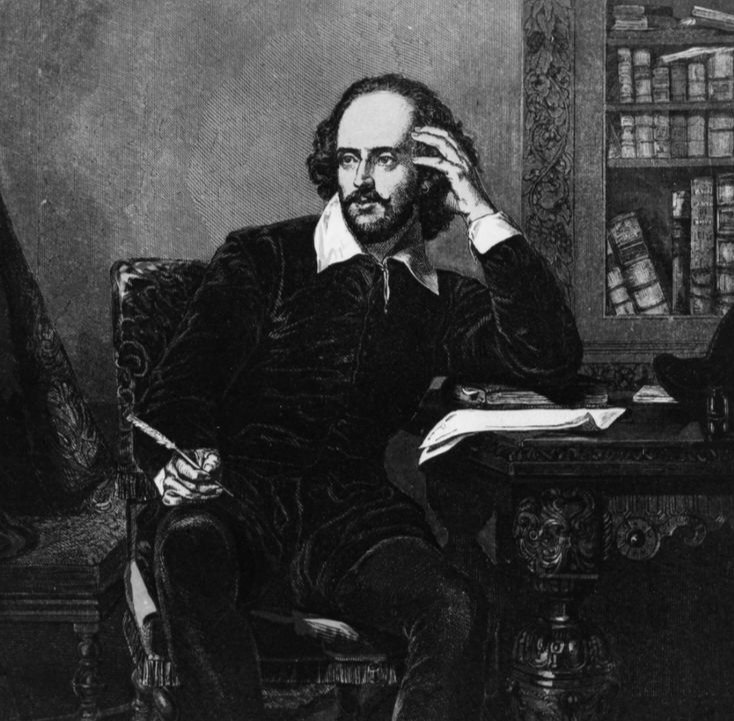
Happy Birthday+Deathday William Shakespeare
Born: April 23, 1564
Died: April 23, 1616
A contemporary of Johannes Kepler, Tycho Brahe, Francis Bacon, & Galileo
25 October 1400. Geoffrey Chaucer, author of The Canterbury Tales, died (aged 56 or 57). He’s been called the “Father of English literature”. He’s buried in Poets’ Corner in Westminster Abbey next to the memorial statue of William Shakespeare.
"Je me sens toujours heureux, savez vous pourquoi ? Parce que je n'attends rien de personne. Les attentes font toujours mal, la vie est courte. Aimez votre vie, soyez heureux, gardez le sourire et souvenez vous : avant de parler, écoutez. Avant d'écrire, réfléchissez. Avant de prier, pardonnez. Avant de blesser, considérez l'autre. Avant de détester, aimez et avant de mourir, vivez."
William Shakespeare
“The man that hath no music in himself, Nor is not moved with concord of sweet sounds, Is fit for treasons, stratagems, and spoils; The motions of his spirit are dull as night, And his affections dark as Erebus. Let no such man be trusted.”
― William Shakespeare, The Merchant of Venice
El Día Internacional del Libro se celebra el 23 de abril porque en esa fecha, en 1616, fallecieron dos gigantes de la literatura: William Shakespeare y Miguel de Cervantes. La UNESCO estableció este día en 1995 para rendir homenaje a los libros, los autores y fomentar la lectura.
A realistic list of 43 classics every
high schooler should read before
graduation:
1. Genesis, The Bible
2. The Odyssey, Homer
3. Oedipus Rex, Sophocles
4. Antigone, Sophocles
5. Beowulf, Anonymous
6. The Canterbury Tales, Geoffrey Chaucer
7. The Gospel According to Matthew, The Bible
8. Romeo and Juliet, William Shakespeare
9. Macbeth, William Shakespeare
10. Hamlet, William Shakespeare
11. Julius Caesar, William Shakespeare
12. Pride and Prejudice, Jane Austen
13. Jane Eyre, Charlotte Brontë
14. Great Expectations, Charles Dickens
15. A Tale of Two Cities, Charles Dickens
16. Silas Marner, George Eliot
17. The Scarlet Letter, Nathaniel Hawthorne
18. Narrative of the Life of Frederick Douglass, an American Slave, Frederick Douglass
19. The Adventures of Huckleberry Finn, Mark Twain
20. The Picture of Dorian Gray, Oscar Wilde
21. Heart of Darkness, Joseph Conrad
22. The Jungle, Upton Sinclair
23. The Great Gatsby, F. Scott Fitzgerald
24. As I Lay Dying, William Faulkner
25. The Grapes of Wrath, John Steinbeck
26. Of Mice and Men, John Steinbeck
27. The Old Man and the Sea, Ernest Hemingway
28. To Kill a Mockingbird, Harper Lee
29. Lord of the Flies, William Golding
30. Animal Farm, George Orwell
31. 1984, George Orwell
32. Fahrenheit 451, Ray Bradbury
33. Night, Elie Wiesel
34. The Crucible, Arthur Miller
35. Uncle Tom's Cabin, Harriet Beecher Stowe
36. Brave New World, Aldous Huxley
37. Black Like Me, John Howard Griffin
38. Gulliver's Travels, Jonathan Swift
39. Things Fall Apart, Chinua Achebe
40. The Trial, Franz Kafka
41. And Then There Were None, Agatha Christie
42. Frankenstein, Mary Shelley
43. Our Town, Thorton Wilder
tolle lege
To celebrate the birthday of William Shakespeare, I’m sharing a few lines from my most favorite sonnet, Sonnet 116. I’ve converted a few of my friends to its cause, and I’m hoping you’re next. Cheers!
You can hear the entire collection in “Patrick Stewart Performs the Complete Sonnets of William Shakespeare” available now:
@SimonAudio#NationalShakespeareDay
@aesquinca#CaminitoALaEscuela Hamlet es una tragedia escrita por William Shakespeare sobre un príncipe de Dinamarca que busca vengar el asesinato de su padre.
Sonnet 73
by William Shakespeare
That time of year thou mayst in me behold
When yellow leaves, or none, or few, do hang
Upon those boughs which shake against the cold,
Bare ruin'd choirs, where late the sweet birds sang.
In me thou see'st the twilight of such day
As after sunset fadeth in the west,
Which by and by black night doth take away,
Death's second self, that seals up all in rest.
In me thou see'st the glowing of such fire
That on the ashes of his youth doth lie,
As the death-bed whereon it must expire,
Consum'd with that which it was nourish'd by.
This thou perceiv'st, which makes thy love more strong,
To love that well which thou must leave ere long.