The AI Ecosystem Is Much Bigger Than ChatGPT. Here’s Your Roadmap to Understanding It. 🚀
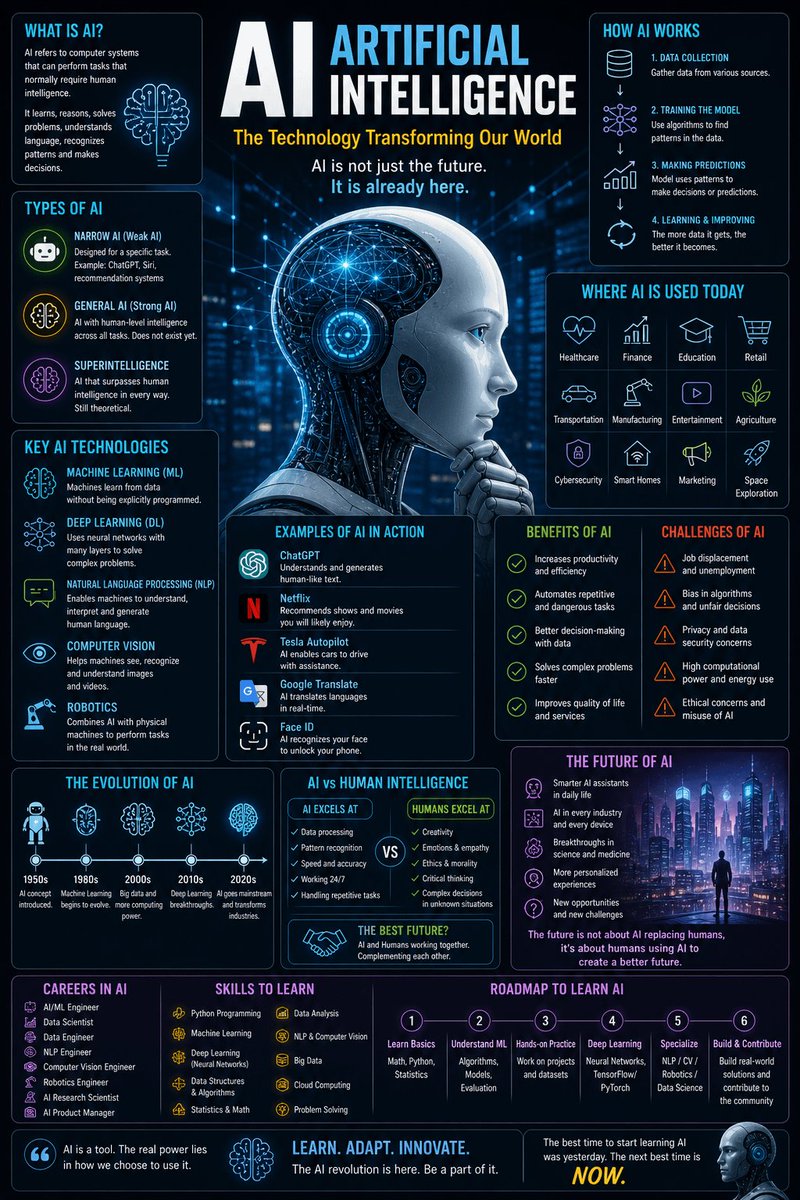
Artificial Intelligence is not just about writing prompts or generating images anymore. It is an entire ecosystem of interconnected tools, frameworks, databases, and intelligent systems working together to build the next generation of software.
If you want to understand where AI is heading, you need to look beyond the popular tools and explore the technologies powering AI applications behind the scenes.
LLMs (Large Language Models)
The foundation of modern AI. Models from OpenAI, Anthropic, Google, Meta, and others power reasoning, writing, coding, research, and countless AI-powered applications.
Agentic AI
AI systems that can plan tasks, use tools, make decisions, and execute multi-step workflows instead of simply responding to a single prompt.
RAG (Retrieval-Augmented Generation)
A powerful approach that allows AI to retrieve relevant information from external knowledge sources before generating an answer. It helps make AI applications more useful for company documents, research, and specialized knowledge.
Embeddings
Embeddings transform text and other data into numerical representations that help machines understand semantic relationships, find similar information, and retrieve relevant context.
MCP (Model Context Protocol)
MCP helps AI applications connect with external tools, data sources, and services through a standardized protocol, making it easier to build connected AI workflows.
AI Security
As AI adoption grows, protecting models, data, tools, and agent workflows becomes essential. Security frameworks help address risks such as unauthorized access, unsafe actions, and prompt injection.
Observability
Building an AI application is only the beginning. Developers also need to monitor performance, latency, costs, traces, errors, and output quality to make systems reliable.
Memory
Memory allows AI applications to retain and retrieve relevant information across interactions, helping create more consistent and context-aware experiences.
AI Agents
AI agents combine models, tools, instructions, and sometimes memory to accomplish specific goals. They can support research, coding, customer service, and business automation.
Automation
Tools such as Zapier, Make, and workflow orchestration platforms connect applications and automate repetitive processes, reducing manual work and improving productivity.
Vector Databases
Vector databases store and retrieve embeddings efficiently, enabling semantic search, recommendation systems, and many RAG applications.
The biggest lesson?
The future of AI will not be built by models alone. It will be shaped by the entire ecosystem surrounding them.
The real opportunity is understanding how these components work together to solve practical problems.
You don't need to learn every tool on this map at once. Start with LLMs, understand RAG and embeddings, explore AI agents, and then move into MCP, automation, security, and observability as your skills grow.
Learn the fundamentals first. Choose tools based on the problems you want to solve. Build real projects. Keep experimenting.
Because in the AI era, knowing which tools exist is useful—but knowing how to combine them is a real advantage.
Follow me 👉
@alexhalescoder for more AI information
Which area of the AI ecosystem are you learning or building with right now:
AI agents, RAG, automation, or something else? 👇
#ArtificialIntelligence #AITools #AIAgents #GenerativeAI #TechInnovation