TEN (🔟/🔟)
@tenprotocol
The privacy L2 for Ethereum. Powered by TEEs. Built for the new internet.
86 Following137K Followers2.7K Posts
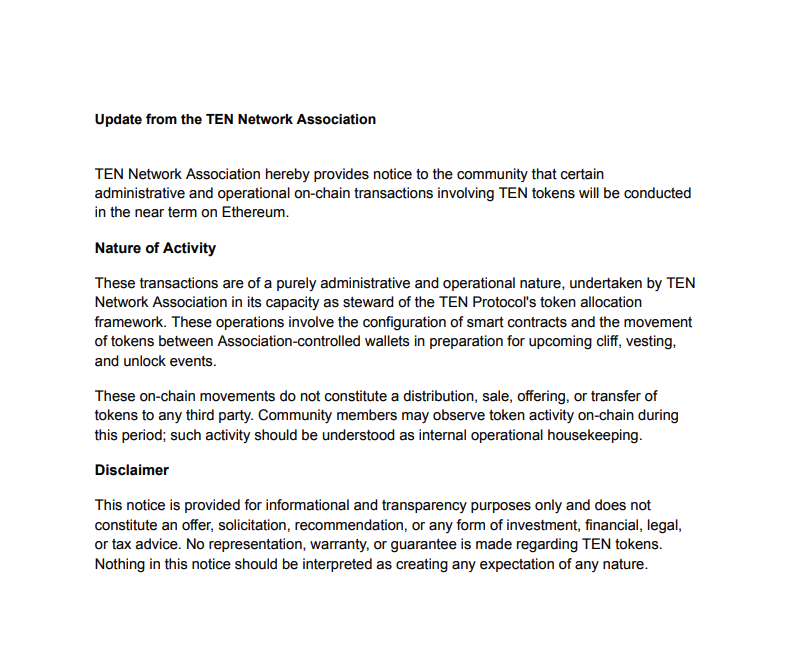
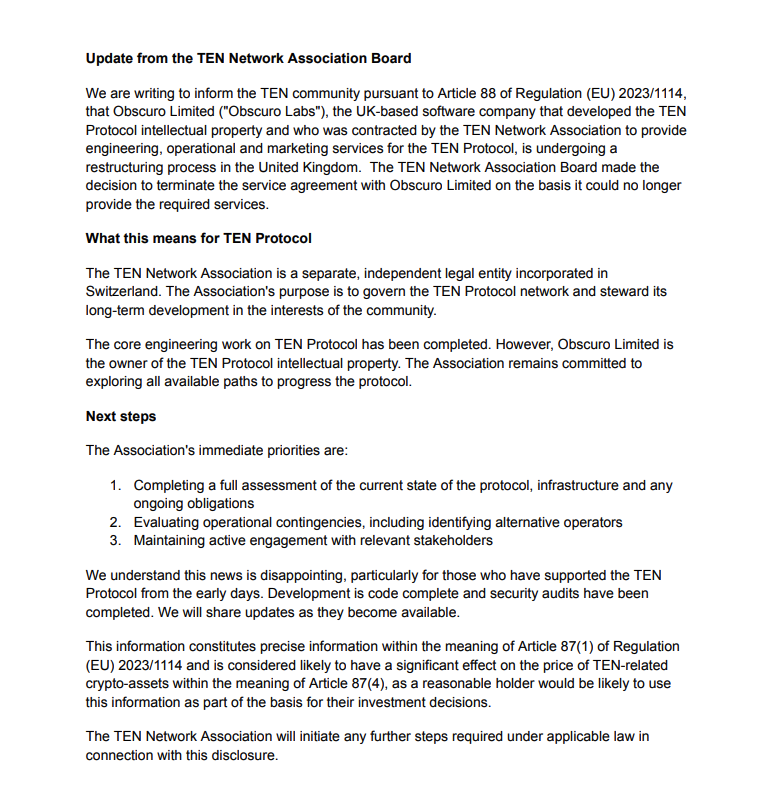
- TEN (🔟/🔟)@tenprotocolAnnouncementTen Network Association @TenAssociationUpdate from the TEN Network Association Board1562411.7K

- TEN (🔟/🔟)@tenprotocolHey Devs. CipherSwap is open for you to extend. Build private pools. Add private token support. Fork the interface and make it yours. –- Get your known flow into work on TENTEN (🔟/🔟) @tenprotocolEvery trade you make on a DEX is public before it settles. Bots see it. Front-run it. Sandwich it. You pay the tax. CipherSwap on TEN demonstrates how you can encrypt your swaps at the chain level. No mempool sniping. No sandwich attacks. Just your trade, executed. Live on testnet:239409.3K
- TEN (🔟/🔟)@tenprotocolEvery trade you make on a DEX is public before it settles. Bots see it. Front-run it. Sandwich it. You pay the tax. CipherSwap on TEN demonstrates how you can encrypt your swaps at the chain level. No mempool sniping. No sandwich attacks. Just your trade, executed. Live on testnet:9123715.3K
- TEN (🔟/🔟)@tenprotocol" What would I do today if I were an L2? - Identify a value add other than "scaling". Examples: (i) non-EVM specialized features/VMs around privacy" We've said this years for years - L2s should not be just for scalingvitalik.eth @VitalikButerinThere have recently been some discussions on the ongoing role of L2s in the Ethereum ecosystem, especially in the face of two facts: * L2s' progress to stage 2 (and, secondarily, on interop) has been far slower and more difficult than originally expected * L1 itself is scaling, fees are very low, and gaslimits are projected to increase greatly in 2026 Both of these facts, for their own separate reasons, mean that the original vision of L2s and their role in Ethereum no longer makes sense, and we need a new path. First, let us recap the original vision. Ethereum needs to scale. The definition of "Ethereum scaling" is the existence of large quantities of block space that is backed by the full faith and credit of Ethereum - that is, block space where, if you do things (including with ETH) inside that block space, your activities are guaranteed to be valid, uncensored, unreverted, untouched, as long as Ethereum itself functions. If you create a 10000 TPS EVM where its connection to L1 is mediated by a multisig bridge, then you are not scaling Ethereum. This vision no longer makes sense. L1 does not need L2s to be "branded shards", because L1 is itself scaling. And L2s are not able or willing to satisfy the properties that a true "branded shard" would require. I've even seen at least one explicitly saying that they may never want to go beyond stage 1, not just for technical reasons around ZK-EVM safety, but also because their customers' regulatory needs require them to have ultimate control. This may be doing the right thing for your customers. But it should be obvious that if you are doing this, then you are not "scaling Ethereum" in the sense meant by the rollup-centric roadmap. But that's fine! it's fine because Ethereum itself is now scaling directly on L1, with large planned increases to its gas limit this year and the years ahead. We should stop thinking about L2s as literally being "branded shards" of Ethereum, with the social status and responsibilities that this entails. Instead, we can think of L2s as being a full spectrum, which includes both chains backed by the full faith and credit of Ethereum with various unique properties (eg. not just EVM), as well as a whole array of options at different levels of connection to Ethereum, that each person (or bot) is free to care about or not care about depending on their needs. What would I do today if I were an L2? * Identify a value add other than "scaling". Examples: (i) non-EVM specialized features/VMs around privacy, (ii) efficiency specialized around a particular application, (iii) truly extreme levels of scaling that even a greatly expanded L1 will not do, (iv) a totally different design for non-financial applications, eg. social, identity, AI, (v) ultra-low-latency and other sequencing properties, (vi) maybe built-in oracles or decentralized dispute resolution or other "non-computationally-verifiable" features * Be stage 1 at the minimum (otherwise you really are just a separate L1 with a bridge, and you should just call yourself that) if you're doing things with ETH or other ethereum-issued assets * Support maximum interoperability with Ethereum, though this will differ for each one (eg. what if you're not EVM, or even not financial?) From Ethereum's side, over the past few months I've become more convinced of the value of the native rollup precompile, particuarly once we have enshrined ZK-EVM proofs that we need anyway to scale L1. This is a precompile that verifies a ZK-EVM proof, and it's "part of Ethereum", so (i) it auto-upgrades along with Ethereum, and (ii) if the precompile has a bug, Ethereum will hard-fork to fix the bug. The native rollup precompile would make full, security-council-free, EVM verification accessible. We should spend much more time working out how to design it in such a way that if your L2 is "EVM plus other stuff", then the native rollup precompile would verify the EVM, and you only have to bring your own prover for the "other stuff" (eg. Stylus). This might involve a canonical way of exposing a lookup table between contract call inputs and outputs, and letting you provide your own values to the lookup table (that you would prove separately). This would make it easy to have safe, strong, trustless interoperability with Ethereum. It also enables synchronous composability (see: and ). And from there, it's each L2's choice exactly what they want to build. Don't just "extend L1", figure out something new to add. This of course means that some will add things that are trust-dependent, or backdoored, or otherwise insecure; this is unavoidable in a permissionless ecosystem where developers have freedom. Our job should make to make it clear to users what guarantees they have, and to build up the strongest Ethereum that we can.1410427.9K
 There have recently been some discussions on the ongoing role of L2s in the Ethereum ecosystem, especially in the face of two facts: * L2s' progress to stage 2 (and, secondarily, on interop) has been far slower and more difficult than originally expected * L1 itself is scaling, fees are very low, and gaslimits are projected to increase greatly in 2026 Both of these facts, for their own separate reasons, mean that the original vision of L2s and their role in Ethereum no longer makes sense, and we need a new path. First, let us recap the original vision. Ethereum needs to scale. The definition of "Ethereum scaling" is the existence of large quantities of block space that is backed by the full faith and credit of Ethereum - that is, block space where, if you do things (including with ETH) inside that block space, your activities are guaranteed to be valid, uncensored, unreverted, untouched, as long as Ethereum itself functions. If you create a 10000 TPS EVM where its connection to L1 is mediated by a multisig bridge, then you are not scaling Ethereum. This vision no longer makes sense. L1 does not need L2s to be "branded shards", because L1 is itself scaling. And L2s are not able or willing to satisfy the properties that a true "branded shard" would require. I've even seen at least one explicitly saying that they may never want to go beyond stage 1, not just for technical reasons around ZK-EVM safety, but also because their customers' regulatory needs require them to have ultimate control. This may be doing the right thing for your customers. But it should be obvious that if you are doing this, then you are not "scaling Ethereum" in the sense meant by the rollup-centric roadmap. But that's fine! it's fine because Ethereum itself is now scaling directly on L1, with large planned increases to its gas limit this year and the years ahead. We should stop thinking about L2s as literally being "branded shards" of Ethereum, with the social status and responsibilities that this entails. Instead, we can think of L2s as being a full spectrum, which includes both chains backed by the full faith and credit of Ethereum with various unique properties (eg. not just EVM), as well as a whole array of options at different levels of connection to Ethereum, that each person (or bot) is free to care about or not care about depending on their needs. What would I do today if I were an L2? * Identify a value add other than "scaling". Examples: (i) non-EVM specialized features/VMs around privacy, (ii) efficiency specialized around a particular application, (iii) truly extreme levels of scaling that even a greatly expanded L1 will not do, (iv) a totally different design for non-financial applications, eg. social, identity, AI, (v) ultra-low-latency and other sequencing properties, (vi) maybe built-in oracles or decentralized dispute resolution or other "non-computationally-verifiable" features * Be stage 1 at the minimum (otherwise you really are just a separate L1 with a bridge, and you should just call yourself that) if you're doing things with ETH or other ethereum-issued assets * Support maximum interoperability with Ethereum, though this will differ for each one (eg. what if you're not EVM, or even not financial?) From Ethereum's side, over the past few months I've become more convinced of the value of the native rollup precompile, particuarly once we have enshrined ZK-EVM proofs that we need anyway to scale L1. This is a precompile that verifies a ZK-EVM proof, and it's "part of Ethereum", so (i) it auto-upgrades along with Ethereum, and (ii) if the precompile has a bug, Ethereum will hard-fork to fix the bug. The native rollup precompile would make full, security-council-free, EVM verification accessible. We should spend much more time working out how to design it in such a way that if your L2 is "EVM plus other stuff", then the native rollup precompile would verify the EVM, and you only have to bring your own prover for the "other stuff" (eg. Stylus). This might involve a canonical way of exposing a lookup table between contract call inputs and outputs, and letting you provide your own values to the lookup table (that you would prove separately). This would make it easy to have safe, strong, trustless interoperability with Ethereum. It also enables synchronous composability (see: and ). And from there, it's each L2's choice exactly what they want to build. Don't just "extend L1", figure out something new to add. This of course means that some will add things that are trust-dependent, or backdoored, or otherwise insecure; this is unavoidable in a permissionless ecosystem where developers have freedom. Our job should make to make it clear to users what guarantees they have, and to build up the strongest Ethereum that we can.2.5K1.7K9.9K6.4M
- TEN (🔟/🔟)@tenprotocolWe were the first project to use AI Agents in pokerDemis Hassabis @demishassabisThe AI field is in need of harder benchmarks to test capabilities of the latest AI models. This update to @Kaggle Game Arena with werewolf and poker (heads-up) plus chess, gives us new objective measures of real-world skills like planning and decision making under uncertainty.167425.6K
 The AI field is in need of harder benchmarks to test capabilities of the latest AI models. This update to @Kaggle Game Arena with werewolf and poker (heads-up) plus chess, gives us new objective measures of real-world skills like planning and decision making under uncertainty.901611.4K217K
- TEN (🔟/🔟)@tenprotocolTEN (🔟/🔟)RT @DeSuR32: Struggling to spot bots vs humans on social media? 🤖👀 @tenprotocol drops the truth: Use TEEs! They built it with @ten_intern to verify posts are real. No more fake vibes – privacy L2 for Ethereum powering secure, human-proof content. 🔐🚀 What's your take: Bots taking over or tech saving us? #TEN #TENProtocol #Web3 #Crypto #Privacy #AI #Bots #Ethereum #DeFi #MEV0703.3K
- TEN (🔟/🔟)@tenprotocolYou use TEEs. We did it with @ten_internDan Romero @dwrHow do you know if Moltbook posts are actually from a bot and not a human?78315.9K
 How do you know if Moltbook posts are actually from a bot and not a human?357983.7K571K
- TEN (🔟/🔟)@tenprotocolTEN (🔟/🔟)RT @crypto_sov: Paying attention to @tenprotocol...?Coin Bureau @coinbureau🔥JUST IN: VITALIK DONATES 16,384 ETH FOR PRIVACY & DECENTRALIZATION Vitalik Buterin donated 16,384 $ETH to support open, secure infrastructure focused on privacy and decentralization.0803.3K
 🔥JUST IN: VITALIK DONATES 16,384 ETH FOR PRIVACY & DECENTRALIZATION Vitalik Buterin donated 16,384 $ETH to support open, secure infrastructure focused on privacy and decentralization.

 11210288752.9K
- TEN (🔟/🔟)@tenprotocolTEN (🔟/🔟)RT @TX_Observer: $282M stolen → instant XMR swap → ATH from liquidity drain one attacker's exit path = market manipulation for everyone else @tenprotocol encrypts execution ️0502.7K
- TEN (🔟/🔟)@tenprotocolfour years → one network → everything changes this week we show you: ↳ what's inside mainnet ↳ why no other L2 comes close ↳ apps that literally can't exist elsewhere ↳ privacy that devs and users don't even notice TEN isn't a launch. it's the launch. 🔟1614514.5K
- TEN (🔟/🔟)@tenprotocolgm to the builders shipping things that can't exist on transparent chains. you'll meet them soon. 🔟1711444.3K
- TEN (🔟/🔟)@tenprotocolTEN (🔟/🔟)RT @blockchainrptr: Exclusive interview with TEN Protocol on privacy, verifiable execution, and how confidential computing could reshape Ethereum applications.01703.6K
- TEN (🔟/🔟)@tenprotocol✅ TEN mainnet release candidate feature complete ✅ Functionality testing passed ✅ Performance testing passed ⚙️ Load testing in progress ⚙️ “Chaos Monkey” testing in progress 📅 Deployment to Ethereum Sepolia179474.6K
- Show more posts