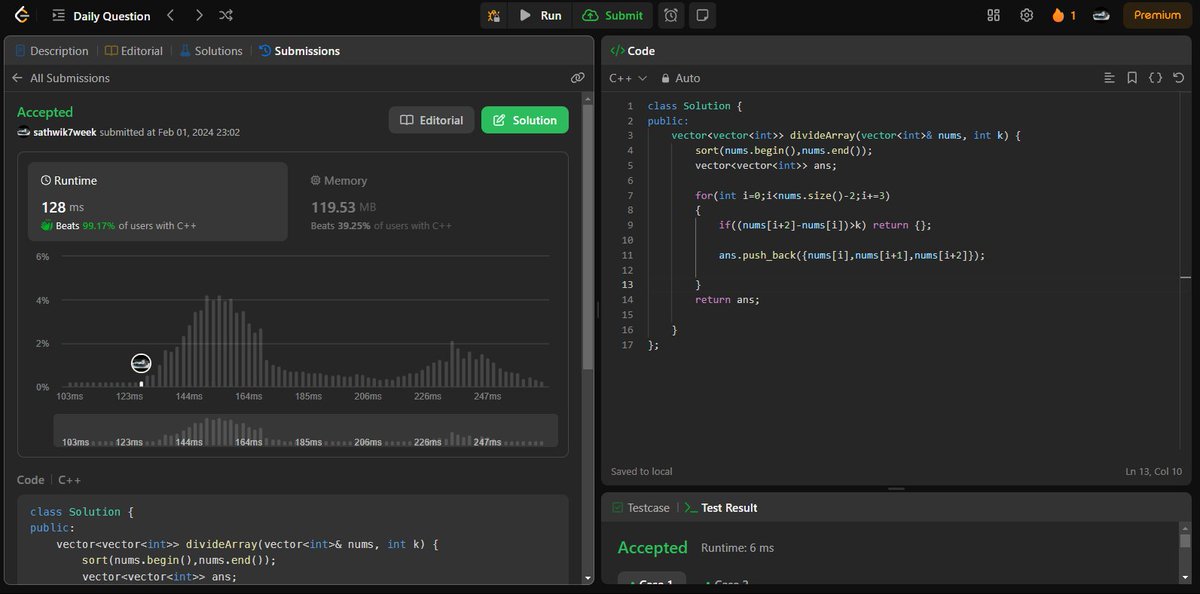
New series explores making your code faster & more efficient. We start with a functional snippet - can you optimize it?
Join the challenge & share your ideas on our forum!
🔗
#Xojo#CodeOptimization#ProgrammingTips#DeveloperChallenge
@elonmusk Sounds like a solid way to level up your C code. Anyone tried it yet? Would love to hear how much faster or cleaner your code got! #CProgramming#CodeOptimization
#100DaysOfCode Kickoff!
Day 1 Progress:
-Problem: 2966
-DP concepts (striver )
Key Learnings:
Using AI for code analysis and optimization
#CodeOptimization
ಸಾಧಾರಣ ಪ್ರಾಜೆಕ್ಟ್ ನಿರ್ಮಾಣ ಮತ್ತು ಪ್ರೊಡಕ್ಷನ್-ಗ್ರೇಡ್ ಕೋಡಿಂಗ್ ನಡುವಿನ ಅಂತರವನ್ನು ಕಡಿಮೆ ಮಾಡಿ. ಪ್ರಾಯೋಗಿಕ ಎಂಜಿನಿಯರಿಂಗ್ ಮಾಡ್ಯೂಲ್ಗಳ ಮೂಲಕ system performance ಮತ್ತು refactoring-ನಲ್ಲಿ ಪರಿಣತಿ ಪಡೆಯಿರಿ.
ಮಾಹಿತಿಗಾಗಿ:
#LearnCode#CodeDebugging#CodeOptimization
📣Deal of the Day📣 Feb 26
45% off TODAY ONLY!
Code Like a Pro in Rust & selected titles: #rustlang#CodeOptimization
Now in print! Get ready to code like a pro in #Rust with insider techniques used by Rust veterans!
New post in our blog!
Learn how AI-driven data center demand is changing the RAM market and get practical tips for optimizing memory usage in your JavaScript applications.
#RAM#JavaScript#CodeOptimization
22 kilobytes.
I often think about the technical limitations that game designers had to work with in the 80s - both in terms of software and hardware. To me, the game that stands at the very top is Elite (1984).
Elite is smaller in data size than many modern text files or desktop icons, yet it lets you freely explore a multi-galaxy-spanning universe that felt gigantic and virtually limitless.
Think about this for a second: The core game code on the BBC Micro version has roughly 22 KB of memory. The C64 version from 1985, which I played as a kid, isn't much bigger.
Now think about what Braben and Bell turned those few kilobytes into: a massive universe with eight galaxies, each containing 256 star systems (for a total of 2,048 planets per system). Each system featured unique details: government type, economy, technology level, population, commodity prices, and even descriptive text.
Oh, and by the way, the game also rendered 3D wireframe ships, stations, and planets in real time on a 2 MHz 6502 processor.
This is no slight on today’s game designers. They work with what they have, and that's okay. But when I think about the worlds that some old school programmers created with the tools they were given, it sometimes breaks my brain trying to to even remotely understand how they did it.
Not megabytes, not gigabytes... kilobytes!
Hey guys, before you think about beefing up that server spec or overhauling your tech stack, take a look at your code. More often than not, the culprit is your own code, not the infrastructure.
#TechTips#Engineering#CodeOptimization#technology#DevOps
"The training material simply isn't good enough for high performance real-time apps such as games, rendering or physics simulation."
#LLMs#CodeOptimization
Share
Copied
Sebastian Aaltonen@SebAaltonen
In my experience LLMs are bad for code optimization. When I am using LLMs, I let the LLM write the boilerplate code and then I rewrite the perf critical parts such as inner loops.
You have to understand performance to instruct LLM to write performant code for you. Super strict instructions about the algorithm and data structures. Then review and tell the LLM exactly what should be fixed and why.
Most of the code in GitHub has performance issues. Idiomatic C++ and Rust code tends to be filled with short lived single object allocations and awful fine grained locking. The training material simply isn't good enough for high performance real-time apps such as games, rendering or physics simulation. You have to be an expert of your respective area and make the architectural/performance decisions yourself. AI is great for writing glue code, gameplay code, UI code and similar, but you should write perf critical inner loops and shaders yourself (AI doesn't really understand SIMD loop/branch coherence).
Tired of repetitive functions in your Flutter projects? 😩 Extensions can simplify your code & boost efficiency!
🎉 Learn how to extend classes, add custom functionality & write cleaner code.
🗒️Check out my blog post:
#Flutter#CodeOptimization
🚀 Want to write faster, smarter C++ code? Dive deep into data structures—from basics to advanced—and learn how to build flexible, efficient libraries for real-world use. #CppDev#CodeOptimization#DataStructures#programming#Cpp 🔍🧱⚙️
🔗
Just solved my first leetcode problem to beat 100% in runtime ! 🧠📷.
Although ChatGPT says "it suffers in maintainability, and scalability". Curious minds, take a look and share your thoughts! #CodeOptimization
🚀 Want to write faster, smarter C++ code? Dive deep into data structures—from basics to advanced—and learn how to build flexible, efficient libraries for real-world use. #CppDev#CodeOptimization#DataStructures#programming#Cpp 🔍🧱⚙️
🔗