If you want to retain info, you have to repeatedly pull it out of your brain, not out of your notes.
The info needs to enter working memory and the way it needs to get there is via long-term memory, not sensory memory.
If you want to retain info, you have to repeatedly pull it out of your brain, not out of your notes.
The info needs to enter working memory and the way it needs to get there is via long-term memory, not sensory memory.
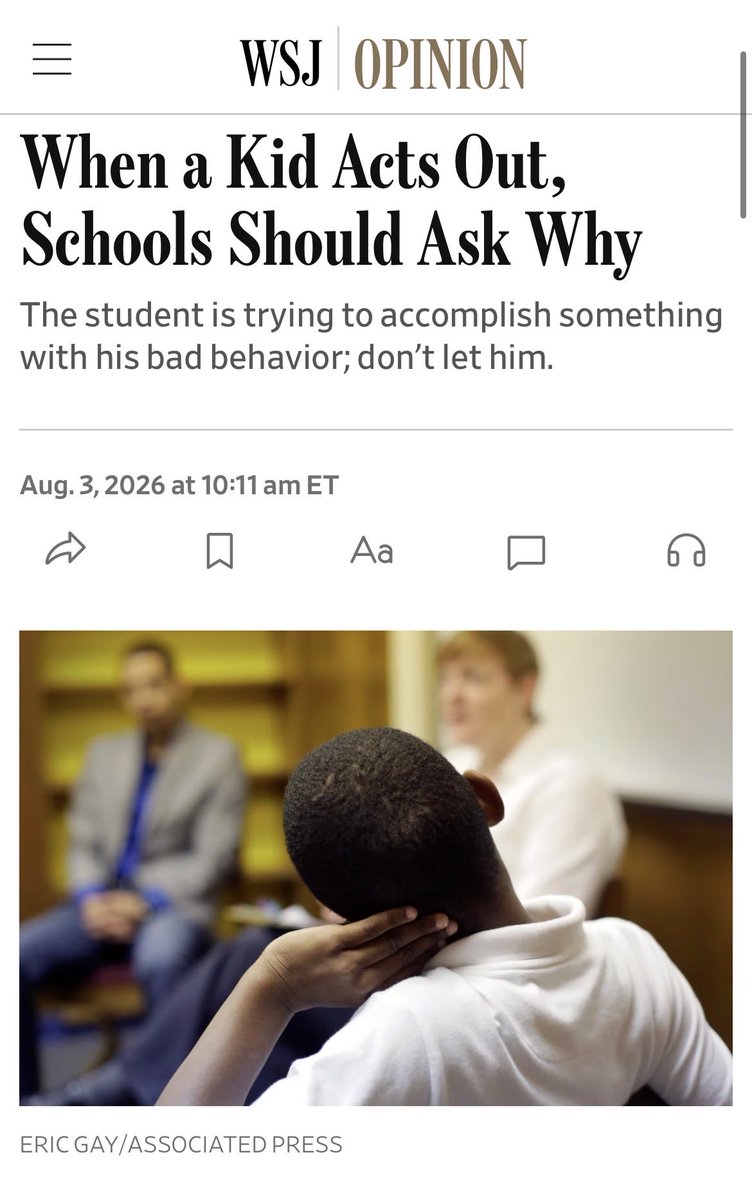
Yep, I've seen this. A student misbehaves in the classroom and goes to the school psychologist or counselor and plays games and draws as part of the therapeutic response. Result: bad behavior is reinforced. Operant conditioning 101.
#EdPsychModules
Share
Copied
Carolyn D. Gorman@CarolynGorman_
Students often act out for one of two reasons: they want to get out of doing something, or they want attention.
Mental health-oriented responses can unintentionally deliver rewards—not consequences—for that misbehavior, which reinforces it.
My @ManhattanInst colleague @DrJenniferWeber & I write in @WSJ:
"Do kids still need to memorize math facts and learn procedures?" Yes! To the point of #automaticity.
#EdPsychModules
Share
Copied
Anna Stokke@rastokke
Do kids still need to memorize math facts and learn procedures? Yes! Knowing stuff is essential for learning new math!
🎧 Full episode below
#MathEducation#ScienceOfLearning#ChalkandTalk
Do kids still need to memorize math facts and learn procedures? Yes! Knowing stuff is essential for learning new math!
🎧 Full episode below
#MathEducation#ScienceOfLearning#ChalkandTalk
There’s a common myth that goes like this: “everybody has the same cognitive horsepower and learns at the same rate, but different people learn differently depending on their preferred learning style.”
In reality, the exact opposite is true. Different people generally have different working memory capacities and learn at different rates. While people may have preferred learning “styles” (e.g. visual vs verbal), they do not actually learn better when given information in their preferred style.
The myth is that different people need the same amount of practice but in different forms – whereas the reality is that different people need the same form of practice but in different amounts.
A guest on @dpshow just mentioned learning styles. Listeners, learning styles ARE MYTHS. They could be the biggest and most harmful myth in all of education.
A guest on @dpshow just mentioned learning styles. Listeners, learning styles ARE MYTHS. They could be the biggest and most harmful myth in all of education.
From Mayer: "Until there is a supportive evidence base, it is best to be skeptical of recommendations to individualize instruction based on learning style."
This is why I continue to include the #learningstylesmyth in #EdPsychModules. My PSA as we begin a new academic year.
This is a brilliant visualisation from Rich Mayer:
"If the learning style principle were correct, you would expect visualizers to perform better on a test after studying a visually based lesson whereas verbalizers should perform better on a test after studying a verbally based lesson—as shown in the graph on the left. In contrast, when Laura Massa and I conducted just such a study, we found results that were more like the graph on the right side of the figure—both verbalizers and visualizers did about the same with a verbally based lesson and both did about the same with a visually based lesson. Like many other studies on the visualizer-verbalizer style dimension, there was no evidence to support the learning style principle. Until there is a supportive evidence base, it is best to be skeptical of recommendations to individualize instruction based on learning style."
University education colleges have the weakest pedagogical knowledge
You can’t make this up. 🤦♂️😓
(highest standard deviation though, implying there is some hope that there are some well-informed professors well placed to lead change)
University education colleges have the weakest pedagogical knowledge
You can’t make this up. 🤦♂️😓
(highest standard deviation though, implying there is some hope that there are some well-informed professors well placed to lead change)
The education system has been lying to you since second grade.
You think you're a visual learner? Or a hands-on learner?
You're not.
"Learning styles" are a myth.
The education system has been lying to you since second grade.
You think you're a visual learner? Or a hands-on learner?
You're not.
"Learning styles" are a myth.
If only teacher prep programs required reading of "How Learning Happens" and "How Teaching Happens" by @P_A_Kirschner & @C_Hendrick we could avoid these outcomes.
Share
Copied
Ammar A. Merhbi@AmmarMerhbi
Teacher prep program: the magical places where you spend years discussing "creating a student-centered learning environment" but somehow graduate without knowing how students actually learn.
Teacher prep program: the magical places where you spend years discussing "creating a student-centered learning environment" but somehow graduate without knowing how students actually learn.
Yep, I've seen this. A student misbehaves in the classroom and goes to the school psychologist or counselor and plays games and draws as part of the therapeutic response. Result: bad behavior is reinforced. Operant conditioning 101.
#EdPsychModules
Share
Copied
Tom Bennett OBE@tombennett71
Rewarding misbehaviour with a therapeutic response can encourage future misbehaviour.
Rewarding misbehaviour with a therapeutic response can encourage future misbehaviour.
Share
Copied
Carolyn D. Gorman@CarolynGorman_
Students often act out for one of two reasons: they want to get out of doing something, or they want attention.
Mental health-oriented responses can unintentionally deliver rewards—not consequences—for that misbehavior, which reinforces it.
My @ManhattanInst colleague @DrJenniferWeber & I write in @WSJ:
*NEW POST* - The Enduring Persistence of Neuromyths in Education. A new study surveying over 3,000 Spanish teachers provides one of the most detailed snapshots to date of educational misconceptions in the field. Link in reply ⬇️
*NEW POST* - The Enduring Persistence of Neuromyths in Education. A new study surveying over 3,000 Spanish teachers provides one of the most detailed snapshots to date of educational misconceptions in the field. Link in reply ⬇️
My #NewYearsResolutions: Debunking these education myths in my #edpsych class for preservice teachers, including "learning styles," "discovery learning is effective," and "learning to read is natural." #EdPsychModules published by @SAGE_Publishing debunks these and other myths.
It's finally here-- in print! #EdPsychModules, 5th edition published by @Sage_Publishing. The 1st and only #edpsych#textbook written from scratch as a modular textbook and with full-length #casestudies. Not even Woolfolk can say that. Did I just say that out loud? Yes, I did! 😊
Good points by @SoLInTheWild regarding student #choice. Also, to be effective, choices need to be optimally challenging. In many cases, allowing students to draw a pic or create a visual representation isn't the same level of challenge as a writing product.
#EdPsychModules
Share
Copied
SoL in the Wild@SoLInTheWild
When we provide novice students with endless choice—“draw a picture or write a paragraph”—in how they process and show their learning (often a learning styles dog whistle), we let them become the expert in something they are not experts in. In certain situations, a visual representation of learning is more appropriate than a verbal one—or vice versa.
Some content demands verbal precision like explaining the steps of cellular respiration or building a historical argument about the causes of the Civil War. Other content demands visual clarity like showing the layers of the Earth.
Better yet, when advantageous, which is in most situations, we should require students to integrate both visual and verbal representations, but again, at our discretion. See the images for example.
We are the experts. We understand how their brains and memories work best; they do not. They are novices in both the content and the learning.
We should be determining how, when, where, and why students learn, based on evidence from cognitive science. Don’t defer to the novices. You’re the expert. The choice needs to be yours.
"trains leaders in Barak Rosenshine’s principles of instruction, which include presenting new material in small, manageable steps & providing extra support for students if the task is especially difficult. The idea is to make learning as accessible as possible to everyone"
"trains leaders in Barak Rosenshine’s principles of instruction, which include presenting new material in small, manageable steps & providing extra support for students if the task is especially difficult. The idea is to make learning as accessible as possible to everyone"
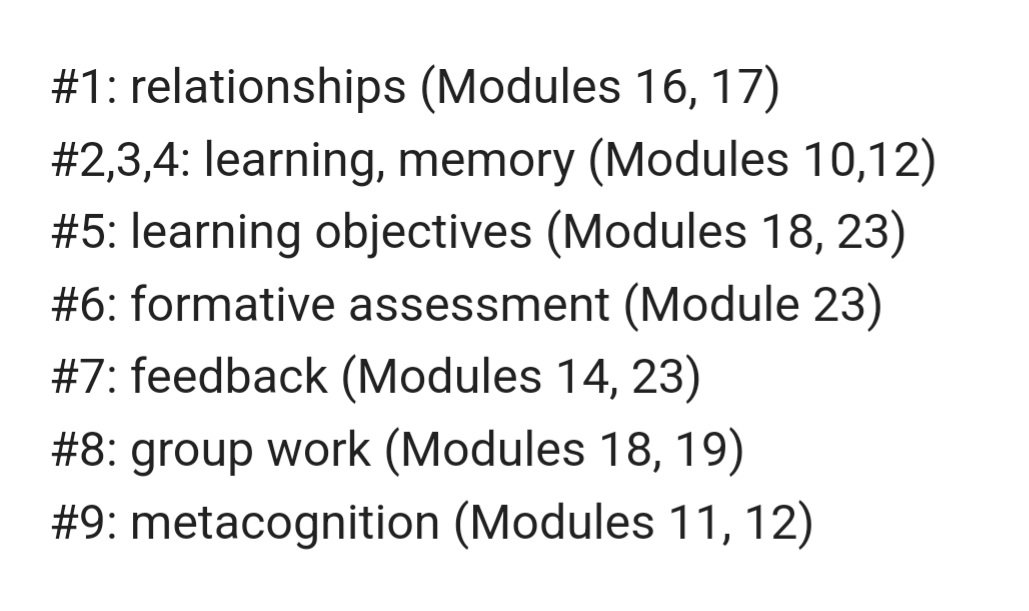
Not sure how I missed this article on 9 important things teachers should know by @dylanwiliam, but I'm glad it was reshared by @KateJones_teach. As I read it, I realized that my textbook for pre-service teachers, #EdPsychModules, covers these topics. Currently revising for 5e!
This is great! It's everything I teach preservice #teachers in #edpsych & covered in #EdPsychModules. I really wish schools/colleges of #education would focus on evidence-based principles of learning. And I'd love to teach a course combining edpsych & curriculum design.
Yes, @MrZachG is spot on. Instructional planning should begin with #learningobjectives, then decide how you want students to show they've met the LOs (i.e., #assessments). Lastly, choose instructional methods & materials to align to LOs & assessment.
#EdPsychModules
Share
Copied
Zach Groshell@MrZachG
I was taught about activities, but never how to plan a lesson. It’s not that the below are bad - it’s that starting with activities rather than designing around targeted goals leads to disjointed learning. I see new and old teachers doing activity-based lesson planning everyday.
I was taught about activities, but never how to plan a lesson. It’s not that the below are bad - it’s that starting with activities rather than designing around targeted goals leads to disjointed learning. I see new and old teachers doing activity-based lesson planning everyday.
I've concluded that teaching elementary math is nearly impossible to do well without strong number sense and mental math skills. Without them, teaching becomes inefficient.
I've concluded that teaching elementary math is nearly impossible to do well without strong number sense and mental math skills. Without them, teaching becomes inefficient.
"Is discovering things for yourself a good way to learn something?" Research shows pure #discoverylearning is generally ineffective, as covered in my textbook #EdPsychModules--learning #myth 9 (in order in which myths appear, not in order of importance).