New paper advised by Li Fei-Fei!
"Generative Representation Learning for Scalable Latent Tokenization"
Image generation commonly uses pretrained encoders like DINO as tokenizers, but these can discard visual details important for generation.
So this paper trains encoders to preserve information shared between masked image views, using a generative model to guide learning.
On ImageNet, it improves FID from 2.36 to 2.18 at similar total training compute, with scaling-law extrapolations suggesting 7–8x less tokenizer training compute than DINOv2 and WebSSL.
A lot of people quote tweeted this as 1 year anniversary of vibe coding. Some retrospective -
I've had a Twitter account for 17 years now (omg) and I still can't predict my tweet engagement basically at all. This was a shower of thoughts throwaway tweet that I just fired off without thinking but somehow it minted a fitting name at the right moment for something that a lot of people were feeling at the same time, so here we are: vibe coding is now mentioned on my Wikipedia as a major memetic "contribution" and even its article is longer. lol
The one thing I'd add is that at the time, LLM capability was low enough that you'd mostly use vibe coding for fun throwaway projects, demos and explorations. It was good fun and it almost worked. Today (1 year later), programming via LLM agents is increasingly becoming a default workflow for professionals, except with more oversight and scrutiny. The goal is to claim the leverage from the use of agents but without any compromise on the quality of the software. Many people have tried to come up with a better name for this to differentiate it from vibe coding, personally my current favorite "agentic engineering":
- "agentic" because the new default is that you are not writing the code directly 99% of the time, you are orchestrating agents who do and acting as oversight.
- "engineering" to emphasize that there is an art & science and expertise to it. It's something you can learn and become better at, with its own depth of a different kind.
In 2026, we're likely to see continued improvements on both the model layer and the new agent layer. I feel excited about the product of the two and another year of progress.
Share
Copied
Andrej Karpathy@karpathy
There's a new kind of coding I call "vibe coding", where you fully give in to the vibes, embrace exponentials, and forget that the code even exists. It's possible because the LLMs (e.g. Cursor Composer w Sonnet) are getting too good. Also I just talk to Composer with SuperWhisper so I barely even touch the keyboard. I ask for the dumbest things like "decrease the padding on the sidebar by half" because I'm too lazy to find it. I "Accept All" always, I don't read the diffs anymore. When I get error messages I just copy paste them in with no comment, usually that fixes it. The code grows beyond my usual comprehension, I'd have to really read through it for a while. Sometimes the LLMs can't fix a bug so I just work around it or ask for random changes until it goes away. It's not too bad for throwaway weekend projects, but still quite amusing. I'm building a project or webapp, but it's not really coding - I just see stuff, say stuff, run stuff, and copy paste stuff, and it mostly works.
There's a new kind of coding I call "vibe coding", where you fully give in to the vibes, embrace exponentials, and forget that the code even exists. It's possible because the LLMs (e.g. Cursor Composer w Sonnet) are getting too good. Also I just talk to Composer with SuperWhisper so I barely even touch the keyboard. I ask for the dumbest things like "decrease the padding on the sidebar by half" because I'm too lazy to find it. I "Accept All" always, I don't read the diffs anymore. When I get error messages I just copy paste them in with no comment, usually that fixes it. The code grows beyond my usual comprehension, I'd have to really read through it for a while. Sometimes the LLMs can't fix a bug so I just work around it or ask for random changes until it goes away. It's not too bad for throwaway weekend projects, but still quite amusing. I'm building a project or webapp, but it's not really coding - I just see stuff, say stuff, run stuff, and copy paste stuff, and it mostly works.
We’re pleased to introduce Make-A-Video, our latest in #GenerativeAI research! With just a few words, this state-of-the-art AI system generates high-quality videos from text prompts.
Have an idea you want to see? Reply w/ your prompt using #MetaAI and we’ll share more results.
The Vibe Code Benchmark has been upgraded by @dryanfurman with collaboration with @FireworksAI_HQ !
Potentially the best way to measure how each model can build apps and software from zero to one.
GPT-6.1 Sol, GPT-6 Astra and Opus 5.5 does exceptionally well on Vibe Coding 0 to 1
Share
Copied
Replit ⠕@Replit
Today we're releasing ViBench 2.0, a benchmark for long-horizon software building. Agents start from an empty project and build a whole product, one feature at a time, without seeing what comes next.
Even the best models (GPT-6.1 Sol, GPT-6 Astra, Opus 5.5) pass every check in only 49-65% of builds.
ViBench 2.0 is now part of @FireworksAI_HQ’s Specialized Intelligence Index, with official results from Fireworks’ runs.
Read more:
Stanford just reinvented text generation.
(it’s neither autoregressive nor diffusion)
Autoregressive LLMs generate one token at a time. Longer answers require longer chains of sequential predictions.
Diffusion LLMs generate many tokens in parallel, but still need repeated refinement passes. Each pass processes the full sequence, and quality drops quickly when you cut the passes.
Stanford researchers proposed another approach, Next-Concept Modeling (NCM). It generates text from coarse structure to fine detail in roughly a dozen passes.
First, a tokenizer learns to represent text as layers of compressed information. Early layers capture broad structure, while later layers add details the earlier ones missed.
A transformer then learns to generate these layers in order, predicting everything within each layer simultaneously. A decoder converts the completed representation into text.
The advantage is that early layers are tiny. Generation needs fewer passes, and those early passes process much less information.
You can see this in the team’s translation example. Early layers produce rough, repetitive text, which later layers refine into a clean translation.
In the researchers’ tests, NCM generated text 10–31× faster than strong diffusion baselines, with comparable or better benchmark scores. On LM1B and OpenWebText, it also used roughly 4–5× fewer training tokens, including tokenizer training.
That speed can also improve quality. Generating several candidates and selecting one based on agreement outperformed diffusion baselines at the same sampling time budget.
The limits matter. Scaling experiments reach 725M parameters, tasks use separate tokenizers, and the release includes evaluation code and checkpoints without a training pipeline.
Some evaluations also use repetition penalties during final decoding, without additional model calls.
NCM shows that parallel generation can work by building increasingly detailed representations. Whether those gains hold at general-purpose LLM scale remains open.
- GitHub repo:
- Paper:
On November 14-17, join us at @Microsoft Ignite to see how the NVIDIA AI platform is bringing new AI capabilities to Microsoft Azure. Read the blog: #GenerativeAI#MSIgnite#NVIDIADGX
We are expanding our partnership with @Lenovo with new hybrid #AI solutions to help enterprises adopt #generativeAI. Read the announcement to learn more:
AI isn't just robots and sci-fi movies! It's a complex world with layers that are changing our reality.
Learn how to build your own AI project, like a chatbot here ➡️
#GenerativeAI#ML#LLM
☕ Java developers, it's time to build more than chatbots! Learn how Spring AI 2.0 and MCP can help you create practical, tool-enabled AI agents. #SpringAI#GenerativeAI
Google DeepMind’s Genie 4 generates interactive worlds with sound and dialogue, and lets users steer scenes as they unfold. Still a research preview for trusted testers.
#AI#GenerativeAI
Last week, @TIME named Fibo, the family of foundation models from @bria_ai_, one of its Best Inventions of 2026. Fibo is built to give enterprises greater control and predictability over #generativeAI image output, and addresses the attribution question that much of the industry has left open.
Read the full feature below:
Embracing AI goes beyond just having the newest models. DM us to discover how @AWS tackles challenges related to value, model selection, security, compliance, and skill development. 🔐 #GenerativeAI
Genie 4 released, real-time generation of virtual worlds
Google DeepMind's Genie 4 is released, capable of generating video and audio of virtual worlds in real time as users interact.
#AI#GenerativeAI#DeepMind
As generative AI tools continue to evolve, we believe it's more important than ever to know what's AI-generated and what isn't. That’s why @GoogleDeepMind launched SynthID in 2023—a technology that adds a hidden digital watermark to AI content.
Here’s a summary of SynthID’s journey and where the provenance technology (the documented history and origin of digital content) is today:
— SynthID watermarking was originally built for images, but now supports video, audio, and text.
— The technology has watermarked over 100 billion images and videos, alongside 60,000 years of audio.
— You can now verify content with SynthID directly in Google Search, Gemini in Chrome, and the @GeminiApp, where it has been utilized over 50 million times.
— We’ve also adopted C2PA Content Credentials across a growing number of our generative AI tools. This includes the images and videos created within the Gemini app. So now, in addition to the SynthID watermark, you can also see where an image or video originated and how it’s been altered.
— We have open-sourced our text watermarking technology, and we are working with companies like @OpenAI, @NVIDIA, and @Apple to apply SynthID to generative media.
Let us know what you think of the tool so far!
One parcel. A little daylight for the night.
A courier opens a box with a sun inside; dark homes begin to glow.
Fenix AI Cinema | Day 3 — bonus experiment. Daily Grok Imagine challenge (@grok). AI fiction.
Prompt below ↓
#GenerativeAI#AIFilmmaking#GrokImagine
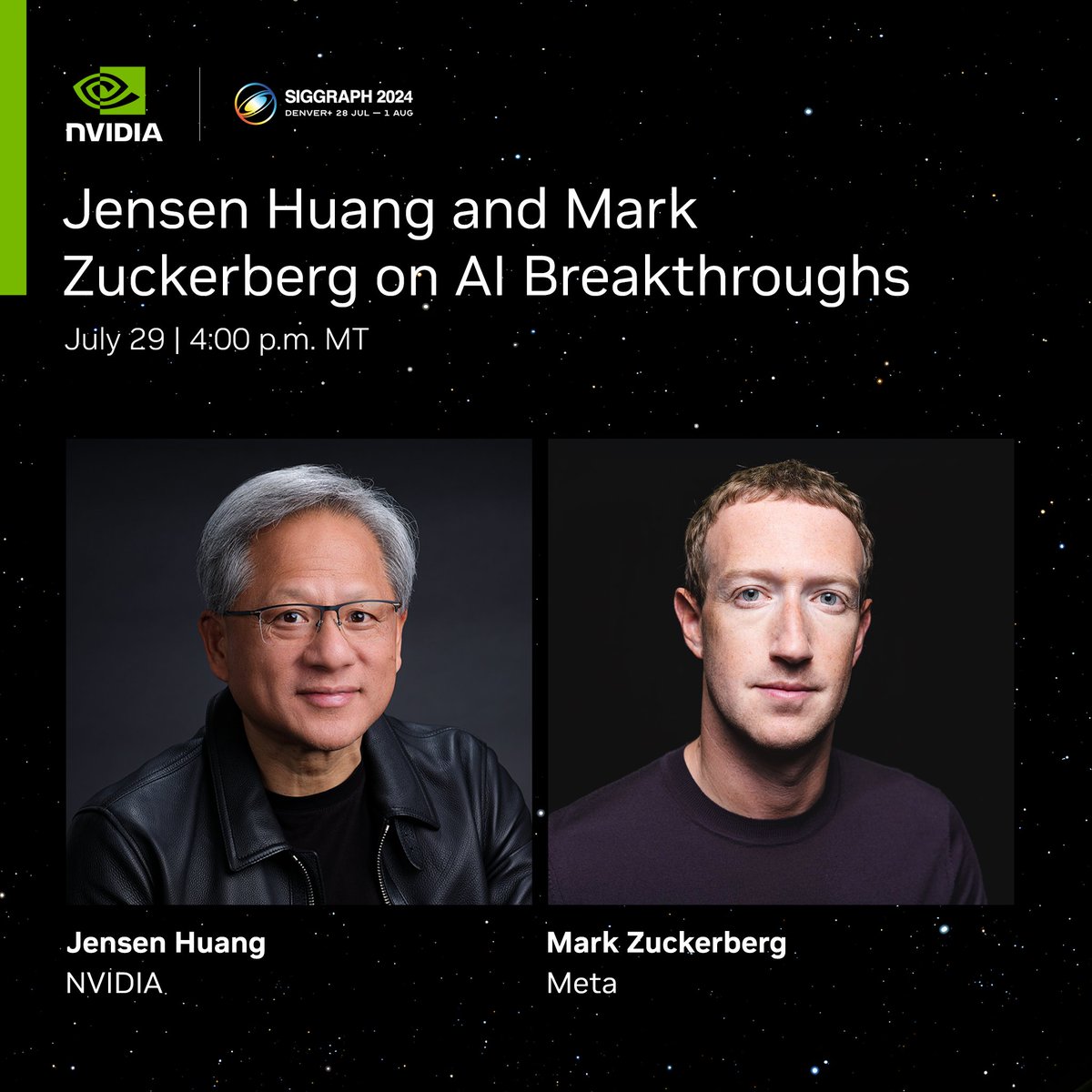
We’re excited to announce that our CEO Jensen Huang will be joined by @Meta CEO Mark Zuckerberg to discuss how research enables AI breakthroughs at #SIGGRAPH2024. Attend the discussion to learn about the intersection of #generativeAI and virtual worlds.