Simon Mo✓

@simon_mo_

building @inferact for @vllm_project

  • Joined
368 Following4.5K Followers631 Posts
  1. Simon Mo✓@simon_mo_
    vLLM has grown to 2000+ contributors scale with a diverse community of model, hardwares, and applications. I see @vllm_project on the path of becoming the world's inference engine and @inferact to accelerate AI progress. We cannot be more excited about the road ahead.
    Woosuk Kwon @woosuk_k
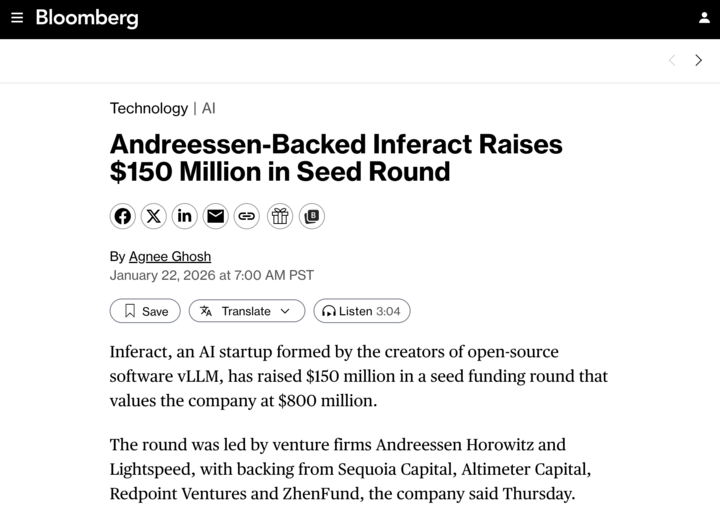
    Today, we're proud to announce @inferact, a startup founded by creators and core maintainers of @vllm_project, the most popular open-source LLM inference engine. Our mission is to grow vLLM as the world's AI inference engine and accelerate AI progress by making inference cheaper and faster. The Challenge Inference is not solved. It's getting harder. Models grow larger. New architectures proliferate: mixture-of-experts, multimodal, agentic. Every breakthrough demands new infrastructure. Meanwhile, hardware fragments: more accelerators, more programming models, and more combinations to optimize. The capability gap between models and the systems that serve them is widening. Left this way, the most capable models remain bottlenecked and with full scope of their capabilities accessible only to those who can build custom infrastructure. Close the gap, and we unlock new possibilities. And the problem is growing. Inference is shifting from a fraction of compute to the majority: test-time compute, RL training loops, synthetic data. We see a future where serving AI becomes effortless. Today, deploying a frontier model at scale requires a dedicated infrastructure team. Tomorrow, it should be as simple as spinning up a serverless database. The complexity doesn't disappear; it gets absorbed into the infrastructure we're building. Why Us vLLM sits at the intersection of models and hardware: a position that took years to build. When model vendors ship new architectures, they work with us to ensure day-zero support. When hardware vendors develop new silicon, they integrate with vLLM. When teams deploy at scale, they run vLLM, from frontier labs to hyperscalers to startups serving millions of users. Today, vLLM supports 500+ model architectures, runs on 200+ accelerator types, and powers inference at global scale. This ecosystem, built with 2,000+ contributors, is our foundation. We've been stewards of this engine since its first commit. We know it inside out. We deployed it at frontier scale—in research and in production. Open Source vLLM was built in the open. That's not changing. Inferact exists to supercharge vLLM adoption. The optimizations we develop flow back to the community. We plan to push vLLM's performance further, deepen support for emerging model architectures, and expand coverage across frontier hardware. The AI industry needs inference infrastructure that isn't locked behind proprietary walls. Join Us Through the open source community, we are fortunate to work with some of the best people we know. For @inferact, we're hiring engineers and researchers to work at the frontier of inference, where models meet hardware at scale. Come build with us. We're fortunate to be supported by investors who share our vision, including @a16z and @lightspeedvp who led our $150M seed, as well as @sequoia, @AltimeterCap, @Redpoint, @ZhenFund, The House Fund, @strikervp, @LaudeVentures, and @databricks. - @woosuk_k, @simon_mo_, @KaichaoYou, @rogerw0108, @istoica05 and the rest of the founding team
    121010626K
  2. Woosuk Kwon✓@woosuk_k
    Today, we're proud to announce @inferact, a startup founded by creators and core maintainers of @vllm_project, the most popular open-source LLM inference engine. Our mission is to grow vLLM as the world's AI inference engine and accelerate AI progress by making inference cheaper and faster. The Challenge Inference is not solved. It's getting harder. Models grow larger. New architectures proliferate: mixture-of-experts, multimodal, agentic. Every breakthrough demands new infrastructure. Meanwhile, hardware fragments: more accelerators, more programming models, and more combinations to optimize. The capability gap between models and the systems that serve them is widening. Left this way, the most capable models remain bottlenecked and with full scope of their capabilities accessible only to those who can build custom infrastructure. Close the gap, and we unlock new possibilities. And the problem is growing. Inference is shifting from a fraction of compute to the majority: test-time compute, RL training loops, synthetic data. We see a future where serving AI becomes effortless. Today, deploying a frontier model at scale requires a dedicated infrastructure team. Tomorrow, it should be as simple as spinning up a serverless database. The complexity doesn't disappear; it gets absorbed into the infrastructure we're building. Why Us vLLM sits at the intersection of models and hardware: a position that took years to build. When model vendors ship new architectures, they work with us to ensure day-zero support. When hardware vendors develop new silicon, they integrate with vLLM. When teams deploy at scale, they run vLLM, from frontier labs to hyperscalers to startups serving millions of users. Today, vLLM supports 500+ model architectures, runs on 200+ accelerator types, and powers inference at global scale. This ecosystem, built with 2,000+ contributors, is our foundation. We've been stewards of this engine since its first commit. We know it inside out. We deployed it at frontier scale—in research and in production. Open Source vLLM was built in the open. That's not changing. Inferact exists to supercharge vLLM adoption. The optimizations we develop flow back to the community. We plan to push vLLM's performance further, deepen support for emerging model architectures, and expand coverage across frontier hardware. The AI industry needs inference infrastructure that isn't locked behind proprietary walls. Join Us Through the open source community, we are fortunate to work with some of the best people we know. For @inferact, we're hiring engineers and researchers to work at the frontier of inference, where models meet hardware at scale. Come build with us. We're fortunate to be supported by investors who share our vision, including @a16z and @lightspeedvp who led our $150M seed, as well as @sequoia, @AltimeterCap, @Redpoint, @ZhenFund, The House Fund, @strikervp, @LaudeVentures, and @databricks. - @woosuk_k, @simon_mo_, @KaichaoYou, @rogerw0108, @istoica05 and the rest of the founding team
    Download
    1831231.2K514K
  3. Simon Mo✓@simon_mo_
    Simon Mo
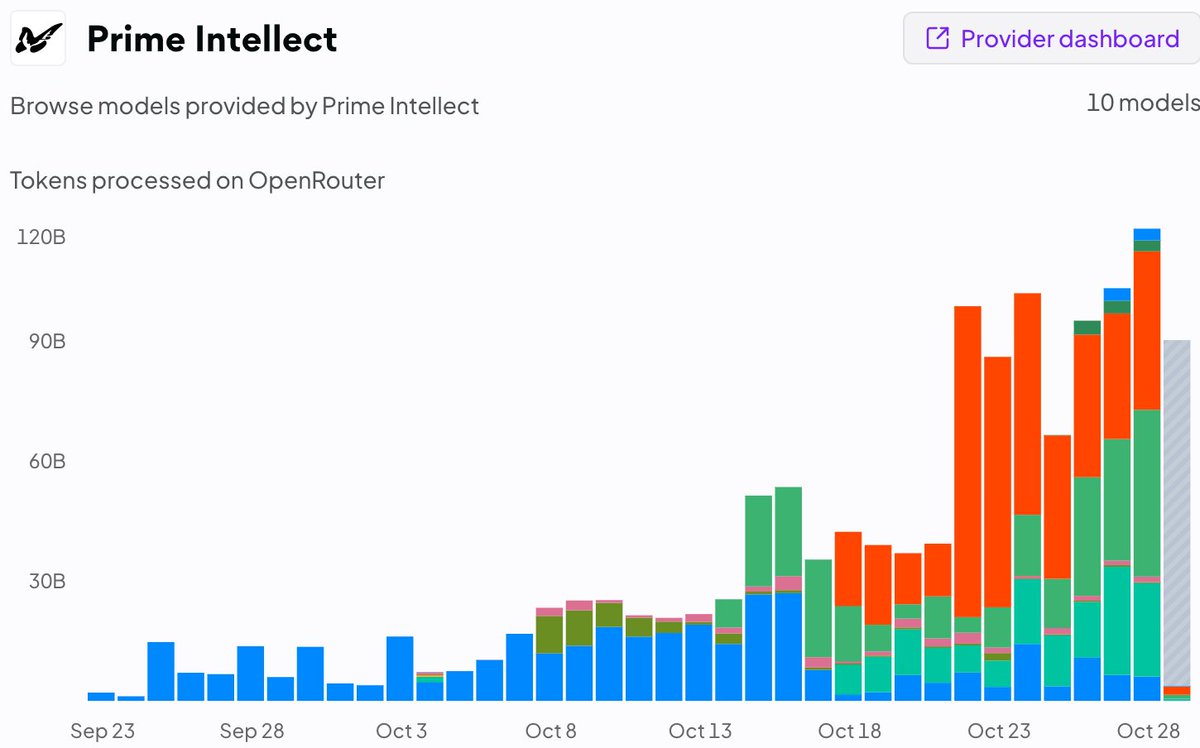
    RT @rogerw0108: Love to see Prime Inference taking off and serving open models at scale, powered by @vllm_project!!
    Stu Cao @caoshuxun
    🚀 0 → 120 BILLION tokens/day in just ONE month! Just one month since onboarding Prime Inference to OpenRouter, we've scaled from zero to 120B tokens served daily. Note this is just a small portion of Prime Inference 🔥
    08022
  4. Stu Cao✓@caoshuxun
    🚀 0 → 120 BILLION tokens/day in just ONE month! Just one month since onboarding Prime Inference to OpenRouter, we've scaled from zero to 120B tokens served daily. Note this is just a small portion of Prime Inference 🔥
    Download
    151612619.3K
  5. Simon Mo✓@simon_mo_
    Simon Mo
    RT @woosuk_k: @jiayq Great insights! I very much agree with every point.
    01013
  6. Simon Mo✓@simon_mo_
    Simon Mo
    RT @woosuk_k: Great work! FWIW, vLLM is moving in the same direction. We've put a lot of work into isolating model-specific code, and it works really nicely now. We've also been considering moving more of the stack to Rust, and your work makes a strong case for it!
    Eric Zhang @ekzhang1
    Alright I finally have more to share on my personal project! Resin is a runtime for building fast LLM inference engines. The idea is to make all the generic parts of inference reusable, and leave only the model-specific forward pass + kernels to be written for each architecture / hardware target. To build an engine: 1. Import Resin's core. 2. Have an agent write a forward pass for the model you’re interested in, for your specific hardware (GPU or TPU or AMD), any kernels you want. Then, boom, you have a standalone inference engine. — I've been hacking over the past month (early post: and recently this week I got a lot of features + parallelisms working, inspired by DeepInfer. For DeepSeek-V4.1-Flash, it's nearly as fast as DeepInfer (within 5-10%), while being self-contained and supporting other models, plus metrics + HTTP server + prefix cache. Yesterday I wrote a skill for authoring models and put Codex to work on it overnight. The agent built a GLM-5.3-Flash engine with MTP, reaching up to 60,000 input tok/s and 16,000 output tok/s on B200 (EP4). So far inference "vibe coding" has not been very reliable or successful. I think it's because people start from scratch each time and reinvent lots of tricky things on the scheduler and server layers. But with a shared core, we can automate lots of inference work. The tricky bit is writing a fast forward pass. But Resin turns that into a standalone engine by just importing a library, and it becomes a verifiable goal for the AI. Code:
    017017
  7. Eric Zhang✓@ekzhang1
    Alright I finally have more to share on my personal project! Resin is a runtime for building fast LLM inference engines. The idea is to make all the generic parts of inference reusable, and leave only the model-specific forward pass + kernels to be written for each architecture / hardware target. To build an engine: 1. Import Resin's core. 2. Have an agent write a forward pass for the model you’re interested in, for your specific hardware (GPU or TPU or AMD), any kernels you want. Then, boom, you have a standalone inference engine. — I've been hacking over the past month (early post: and recently this week I got a lot of features + parallelisms working, inspired by DeepInfer. For DeepSeek-V4.1-Flash, it's nearly as fast as DeepInfer (within 5-10%), while being self-contained and supporting other models, plus metrics + HTTP server + prefix cache. Yesterday I wrote a skill for authoring models and put Codex to work on it overnight. The agent built a GLM-5.3-Flash engine with MTP, reaching up to 60,000 input tok/s and 16,000 output tok/s on B200 (EP4). So far inference "vibe coding" has not been very reliable or successful. I think it's because people start from scratch each time and reinvent lots of tricky things on the scheduler and server layers. But with a shared core, we can automate lots of inference work. The tricky bit is writing a fast forward pass. But Resin turns that into a standalone engine by just importing a library, and it becomes a verifiable goal for the AI. Code:
    Download
    1151041.5K101K
  8. Simon Mo✓@simon_mo_
    Simon Mo
    RT @woosuk_k: We wrote a blog post on how we achieved such great performance on DSV41-Flash. Our results are also verified in the @SemiAnalysis_ AgentX benchmark.
    vLLM @vllm_project
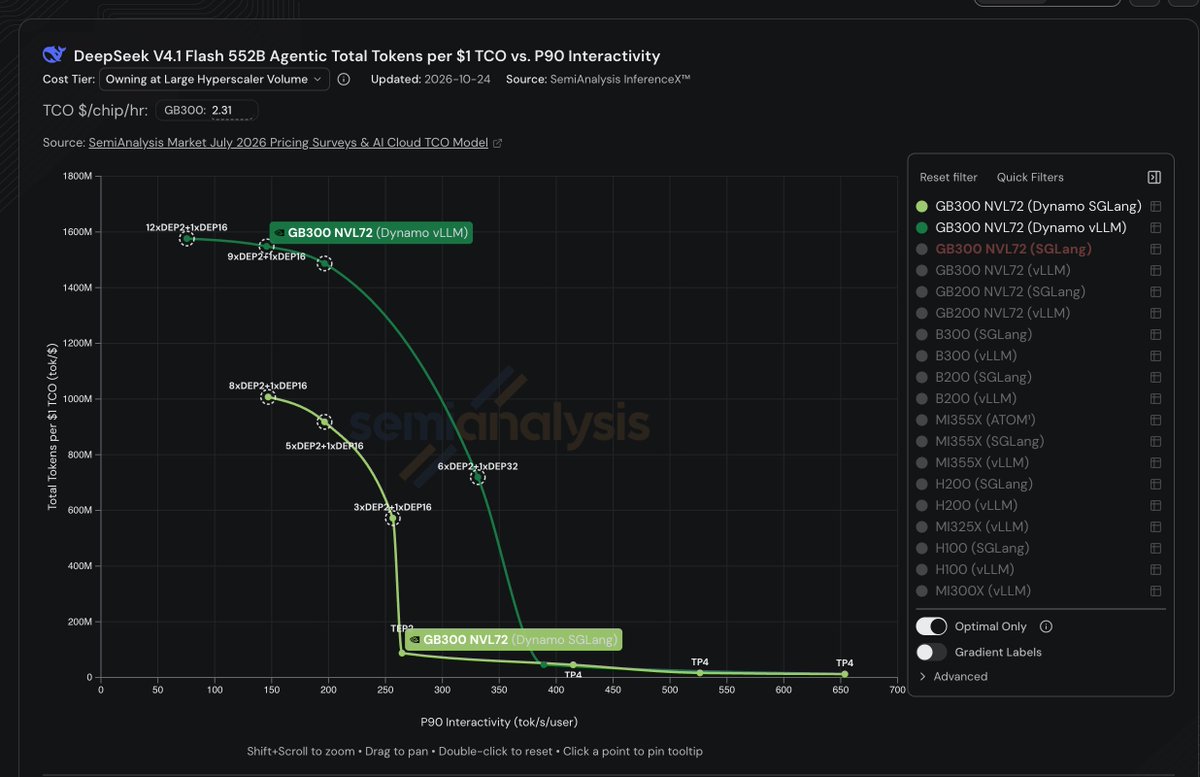
    vLLM matches DeepInfer, DeepSeek's own engine for DeepSeek-V4.1-Flash, on DeepSeek's decode configuration across batch sizes 8 to 256, and does it at DEP32 against DeepInfer’s EP64DP64. DeepInfer was originally built on vLLM. By integrating DeepSeek's open-source kernels and extensively optimizing prefill and decode, vLLM now matches DeepInfer's performance curves.
    013016
  9. Simon Mo✓@simon_mo_
    Simon Mo
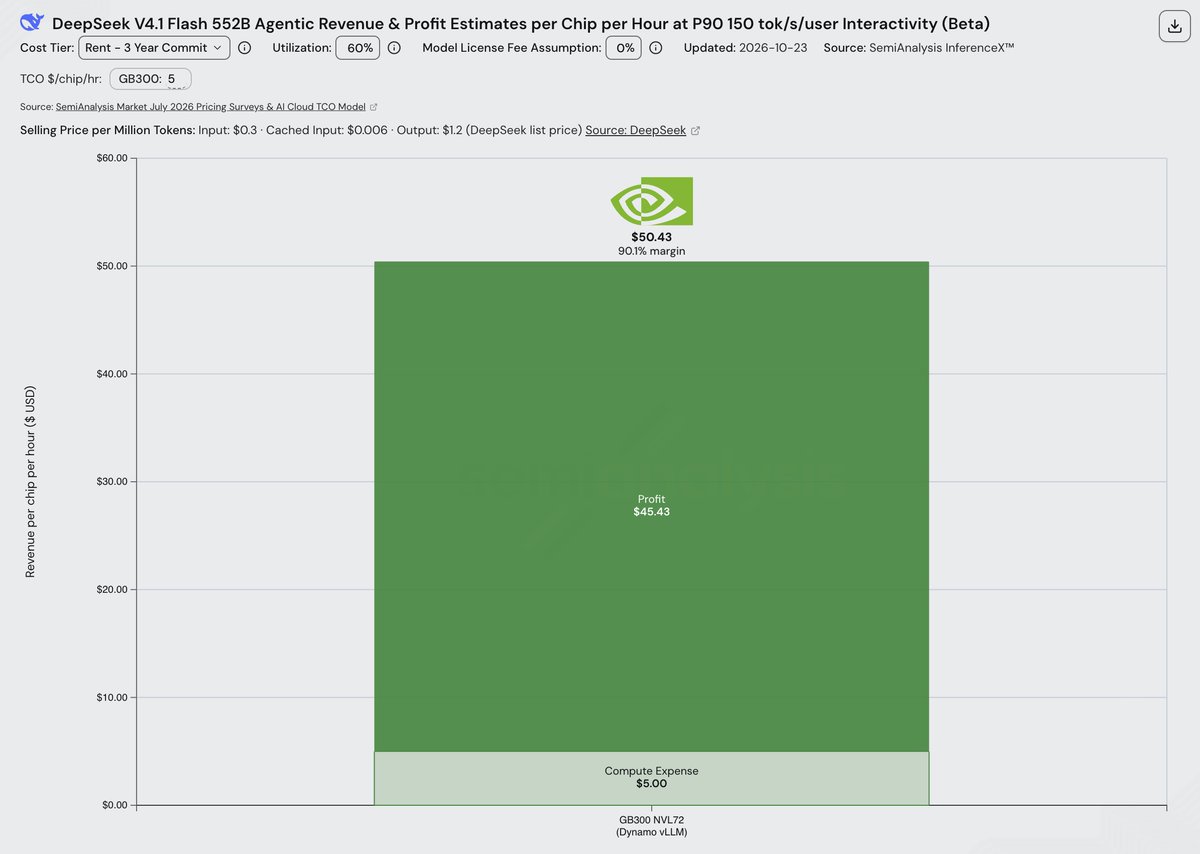
    RT @vllm_project: Beyond matching DeepInfer's performance, we also put vLLM to the test on @SemiAnalysis_ AgentX with real-world agentic workloads. At DeepSeek's off-peak pricing, vLLM delivers $38.96/GPU-hour revenue, with 954K tokens/s/GPU total throughput (cached+input+output) at 196 tokens/s P90 per user. This is the best DeepSeek-V4.1-Flash result on AgentX ever, powered by recent advancement in vLLM! Check out our blog for the full optimization story and how to reproduce the results 👇 Enjoy the read.
    vLLM @vllm_project
    Scaled out with P/D disaggregation and Wide-EP on a GB300 NVL72 rack, vLLM serves V4.1-Flash on SemiAnalysis AgentX at 954K tokens/s per GPU with 196 tokens/s P90 per user, 7.9× our single-node result. Our engineering blog covers the work behind it:
    032014
  10. vLLM✓@vllm_project
    Posts @vllm_project
    Scaled out with P/D disaggregation and Wide-EP on a GB300 NVL72 rack, vLLM serves V4.1-Flash on SemiAnalysis AgentX at 954K tokens/s per GPU with 196 tokens/s P90 per user, 7.9× our single-node result. Our engineering blog covers the work behind it:
    599832.9K
  11. Simon Mo✓@simon_mo_
    Simon Mo
    RT @yifandotqiao: Nice writeup! So glad to see a third party serving DeepSeek-V4.1-Flash with vLLM and reproducing our results! Also love how the blog identifies DeepInfer's Engram RDMA fetch bottleneck, which we've observed and taken seriously as well. Regardless, vLLM is the full-fledged serving engine that takes care of the heavy lifting. Talk is cheap. Try it yourself!
    Kirill Bespalov @kbesplv
    DeepSeek’s DeepInfer vs vLLM on one 8×B300 node: #deepinfer #deepseek #vllm
    08027
  12. Simon Mo✓@simon_mo_
    Simon Mo
    RT @rogerw0108: One important difference in the benchmarking methodologies here is the dataset and the shape of the workload. We care much more about real agentic workloads than random inputs. It’s great that @SemiAnalysis_ provided a comprehensive AgentX platform with full transparency.
    AGTP @AGTPinsights
    VLLM and SGLang both just said they match DeepSeek's new DeepInfer engine. Here's what you need to know. DeepSeek open-sourced DeepInfer on Oct 20 under Apache 2.0. It is the in-house inference engine behind DeepSeek-V4.1-Flash, and it supports NVIDIA GPUs and Huawei chips. It was originally built on vLLM. Now the two big open serving engines are claiming parity with it. vLLM posted first on Oct 25. It says it matches DeepInfer on DeepSeek's decode configuration across batch sizes 8 to 256. It does that at DEP32, against DeepInfer's EP64DP64. vLLM did it by integrating DeepSeek's open-source kernels and heavily optimizing prefill and decode. The work was led by the Inferact team, with help from NVIDIA and SemiAnalysis' AgentX benchmark. SGLang says it matches DeepInfer on both prefill and decode. It first brought in DeepSeek's Mega kernels (MegaMoE, MegaAttention, Mega-mHC, MegaGate), SWA bounded replay and Engram optimizations. Then it added more kernel fusions and breakable CUDA graphs for prefill. Everything is in SGLang main, with an end-to-end reproduction guide. SGLang also points out gaps in DeepInfer's release. It leaves out a KV cache system, prefill/decode disaggregation and load balancing. SGLang ships all three. Its team also says some prefill comparisons mix GB300 results with DeepInfer's published B300 numbers, and argues that makes a fair comparison hard. Key numbers: - vLLM decode: matches DeepInfer at batch sizes 8 to 256, using DEP32 vs EP64DP64 - vLLM on a GB300 NVL72 rack: 954K tokens/s per GPU, 196 tokens/s P90 per user, 7.9x its single-node result - SGLang prefill: up to 1.04x throughput on 4x GB300 and 4x B300 - SGLang decode: up to 7.4% more throughput on 64x GB300 The result is that DeepSeek's release set a performance bar, and the two main open engines reached it within days.
    05020
  13. AGTP✓@AGTPinsights
    VLLM and SGLang both just said they match DeepSeek's new DeepInfer engine. Here's what you need to know. DeepSeek open-sourced DeepInfer on Oct 20 under Apache 2.0. It is the in-house inference engine behind DeepSeek-V4.1-Flash, and it supports NVIDIA GPUs and Huawei chips. It was originally built on vLLM. Now the two big open serving engines are claiming parity with it. vLLM posted first on Oct 25. It says it matches DeepInfer on DeepSeek's decode configuration across batch sizes 8 to 256. It does that at DEP32, against DeepInfer's EP64DP64. vLLM did it by integrating DeepSeek's open-source kernels and heavily optimizing prefill and decode. The work was led by the Inferact team, with help from NVIDIA and SemiAnalysis' AgentX benchmark. SGLang says it matches DeepInfer on both prefill and decode. It first brought in DeepSeek's Mega kernels (MegaMoE, MegaAttention, Mega-mHC, MegaGate), SWA bounded replay and Engram optimizations. Then it added more kernel fusions and breakable CUDA graphs for prefill. Everything is in SGLang main, with an end-to-end reproduction guide. SGLang also points out gaps in DeepInfer's release. It leaves out a KV cache system, prefill/decode disaggregation and load balancing. SGLang ships all three. Its team also says some prefill comparisons mix GB300 results with DeepInfer's published B300 numbers, and argues that makes a fair comparison hard. Key numbers: - vLLM decode: matches DeepInfer at batch sizes 8 to 256, using DEP32 vs EP64DP64 - vLLM on a GB300 NVL72 rack: 954K tokens/s per GPU, 196 tokens/s P90 per user, 7.9x its single-node result - SGLang prefill: up to 1.04x throughput on 4x GB300 and 4x B300 - SGLang decode: up to 7.4% more throughput on 64x GB300 The result is that DeepSeek's release set a performance bar, and the two main open engines reached it within days.
    Download
    vLLM @vllm_project
    vLLM matches DeepInfer, DeepSeek's own engine for DeepSeek-V4.1-Flash, on DeepSeek's decode configuration across batch sizes 8 to 256, and does it at DEP32 against DeepInfer’s EP64DP64. DeepInfer was originally built on vLLM. By integrating DeepSeek's open-source kernels and extensively optimizing prefill and decode, vLLM now matches DeepInfer's performance curves.
    1024.3K
  14. Simon Mo✓@simon_mo_
    Simon Mo
    RT @yifandotqiao: It's easy to make inference benchmarks look impressive with random inputs and idealized expert routing. The harder part is making those numbers hold up on real workloads. Our DeepSeek-V4.1-Flash benchmarks use real input distributions, realistic expert routing, and the same serving configurations validated on @SemiAnalysis_ AgentX. Fun fact: our results have been online since Oct. 20, even before DeepInfer's release. And we'll deliver even more speedups! Synthetic benchmarks have their place, but let's be clear about what they actually measure. Check out our blog for the full optimization story and benchmarking methodology!
    vLLM @vllm_project
    Scaled out with P/D disaggregation and Wide-EP on a GB300 NVL72 rack, vLLM serves V4.1-Flash on SemiAnalysis AgentX at 954K tokens/s per GPU with 196 tokens/s P90 per user, 7.9× our single-node result. Our engineering blog covers the work behind it:
    020023
  15. Simon Mo✓@simon_mo_
    The reason you see us unequivocally talk about @SemiAnalysis_ AgentX as _the_ benchmark to watch up because it directly translate to production performance: it requires real traffic shapes, measured acceptance rate, and in case of @deepseek_ai models, EPLB optimizations.
    Download
    vLLM @vllm_project
    vLLM matches DeepInfer, DeepSeek's own engine for DeepSeek-V4.1-Flash, on DeepSeek's decode configuration across batch sizes 8 to 256, and does it at DEP32 against DeepInfer’s EP64DP64. DeepInfer was originally built on vLLM. By integrating DeepSeek's open-source kernels and extensively optimizing prefill and decode, vLLM now matches DeepInfer's performance curves.
    211462.2K
  16. Simon Mo✓@simon_mo_
    Simon Mo
    RT @inferact: DeepSeek open-sourced DeepInfer this week, the engine behind its own DeepSeek-V4.1-Flash serving. We think it is the most useful kind of release: a purpose-built engine, originally built on @vllm_project, that shows what one model can do on one piece of hardware. Our team got vLLM to match it on DeepSeek's own decode configuration, using half the GPUs, and then kept going to where an offline reference engine does not reach: online serving across a full GB300 NVL72 rack, at 954K tokens/s per GPU on SemiAnalysis AgentX and $38.96 of token value per GPU-hour. Our view is that the gap between a lab’s reference engine and the engine you run in production should be close to zero, and that closing it is mostly careful systems work rather than new algorithms.
    vLLM @vllm_project
    vLLM matches DeepInfer, DeepSeek's own engine for DeepSeek-V4.1-Flash, on DeepSeek's decode configuration across batch sizes 8 to 256, and does it at DEP32 against DeepInfer’s EP64DP64. DeepInfer was originally built on vLLM. By integrating DeepSeek's open-source kernels and extensively optimizing prefill and decode, vLLM now matches DeepInfer's performance curves.
    016022
  17. Simon Mo✓@simon_mo_
    vLLM 🫡 @deepseek_ai DeepInfer
    vLLM @vllm_project
    vLLM matches DeepInfer, DeepSeek's own engine for DeepSeek-V4.1-Flash, on DeepSeek's decode configuration across batch sizes 8 to 256, and does it at DEP32 against DeepInfer’s EP64DP64. DeepInfer was originally built on vLLM. By integrating DeepSeek's open-source kernels and extensively optimizing prefill and decode, vLLM now matches DeepInfer's performance curves.
    50452.4K
  18. Simon Mo✓@simon_mo_
    Simon Mo
    RT @vllm_project: vLLM matches DeepInfer, DeepSeek's own engine for DeepSeek-V4.1-Flash, on DeepSeek's decode configuration across batch sizes 8 to 256, and does it at DEP32 against DeepInfer’s EP64DP64. DeepInfer was originally built on vLLM. By integrating DeepSeek's open-source kernels and extensively optimizing prefill and decode, vLLM now matches DeepInfer's performance curves.
    0121016
  19. Simon Mo✓@simon_mo_
    Simon Mo
    RT @rchpmv: We just had a really tough inference bug that 4x parallel Opus 5.5 agents couldn't figure it out after more than 24 hours. Our Agent V's agent collaboration infra running 16 self-hosted Kimi K3 agents cracked it under 12 hours. Definitely a win for open intelligence!
    03030
  20. Simon Mo✓@simon_mo_
    Among many many highlights, this is the first model with DAY 0 RUBIN SUPPORT
    vLLM @vllm_project
    🎉 MiniMax M3.1 Flash from @MiniMax_AI has Day-0 support in vLLM! Built for multi-step automation, real-codebase engineering and visual reasoning—with native NVFP4 KV, NVFP4 MoE weights and DSpark speculative decoding in the serving stack. What the model can do, and the vLLM engineering that makes it practical to serve. 👇 Model: 1/5
    0122965
  21. vLLM✓@vllm_project
    🎉 MiniMax M3.1 Flash from @MiniMax_AI has Day-0 support in vLLM! Built for multi-step automation, real-codebase engineering and visual reasoning—with native NVFP4 KV, NVFP4 MoE weights and DSpark speculative decoding in the serving stack. What the model can do, and the vLLM engineering that makes it practical to serve. 👇 Model: 1/5
    Download
    173519711.7K
  22. Simon Mo✓@simon_mo_
    Accelerate open intelligence together!!
    0021778
  23. Simon Mo✓@simon_mo_
    Simon Mo
    RT @inferact: Today, we are announcing a strategic partnership with @MiniMax_AI to advance frontier production inference for open-source models. The Inferact Platform has served MiniMax M3.1 Flash in production since the day it launched. Requests through the MiniMax platform are routed to our stack alongside MiniMax’s own capacity, after we met MiniMax’s vendor verification requirements for accuracy and reliability. The Inferact Platform serves this agentic workload with guaranteed SLAs and auto-tunes the endpoint against live traffic, while MiniMax keeps control of how its model is served. Inferact also leads day-0 @vllm_project support for each MiniMax release, so the model serves at production quality the day the weights ship. The engineering from both efforts is upstreamed to vLLM. Thanks to the MiniMax team for the partnership. Read the full announcement:
    014019
  24. Simon Mo✓@simon_mo_
    Simon Mo
    RT @vllm_project: vLLM 🤝 TPU 🚀 Native PyTorch serving on TPUs is here! Built with @Google and @inferact, vLLM-TorchTPU brings familiar PyTorch tools to TPU inference, with prefix caching, speculative decoding, and disaggregated serving. 🛠️ Excited to keep building with the community!
    Google Cloud @googlecloud
    Native PyTorch on TPUs is here—and TorchTPU is officially open source. Train and serve models using the tools you already know: @vllm_project, @sgl_project, @_llm_d_, TorchTitan, @huggingface, and @raydistributed. Learn more from #PyTorchConf2026 →
    025015
  25. Simon Mo✓@simon_mo_
    Simon Mo
    RT @vllm_project: Day-0 support for @Recursive_SI's Flint is here in vLLM! 🚀 40B parameters, just 2.5B active per token. Thanks to the small size, our custom NVFP4 kernels push it to 500 TPS on a single GB200, even at 100K context without speculative decoding. Both NVFP4 and BF16 are ready to run today!
    Richard Socher @RichardSocher
    Introducing Flint, @Recursive_SI’s first model: a fast local coding model built with our automated research system, the Eureka Machine. • Best-in-class fast local coding • Up to 2x faster than comparable models: 125+ tokens/sec on a MacBook Pro, 150+ on RTX Spark • Built from scratch in under 4 months Private, unmetered intelligence on your own machine. Open weights available now on @huggingface, run it locally on your favorite framework or try it for free on @opencode or @pidotdev.
    023011
  26. Richard Socher✓@RichardSocher
    Introducing Flint, @Recursive_SI’s first model: a fast local coding model built with our automated research system, the Eureka Machine. • Best-in-class fast local coding • Up to 2x faster than comparable models: 125+ tokens/sec on a MacBook Pro, 150+ on RTX Spark • Built from scratch in under 4 months Private, unmetered intelligence on your own machine. Open weights available now on @huggingface, run it locally on your favorite framework or try it for free on @opencode or @pidotdev.
    Download
    6388938.4K3.4M
  27. Show more posts