Posts with #Transcriptomics
#Transcriptomics
Public posts on X that use #Transcriptomics.
Related hashtags

Transmitting Science | Online courses and more@TransmitScience🧬 What can gene expression tell us about biological processes? Our 4th edition of Bioinformatic Tools for Transcriptomic Data Analyses is coming! Join us to explore bioinformatic approaches for analysing RNA-seq and transcriptomic datasets. #TScourses #KeepLearning111162
Nature, Published online: 04 November 2026; doi:10.1038/s41586-026-11234-8A deep single-cell and spatial multi-omic atlas of human glioblastoma is generated, pairing transcriptomic, epigenomic and genomic profiling, and tracing glioblastoma tumour heteroge00013
🫁 What did COVID-19 do to the lungs of those who lost their lives? Our new @NatureComms paper maps it with #spatial #transcriptomics: 🔴 Massive fibrosis 🔥 Persistent inflammation 🩹 Failed alveolar repair Brilliant work by PhD student @carlosgarciapri 👏 #COVID19015642.9K
The science of #immunotherapy can cure a patient's otherwise incurable cancer. But sometimes immunotherapy fails completely Shockingly, we hardly know why. A meta-analysis of #Genomics & #Transcriptomics in >1,000 immunotherapy-treated patients aims to better understand why🧵916046475.5K
A group of researchers proposes a standardized classification and nomenclature of cell types in the cortex based on single-cell #transcriptomics244119
Paul Geeleher@PGeeleherOut now in @CellCellPress, Tabula Sapiens 2.0: A comprehensive transcriptomic atlas of human cell types.00087
allen institute@AllenInstitute🎶 Listen to the Sounds of Science from our RNA Sequencing lab. ••• Single cell #transcriptomics assayed from over 16,000 cells in three regions of the brain are publicly available for download via | #OpenScience12045
James Zou@james_y_zouNew in @naturemethods! We introduce TISSUE, an uncertainty-aware framework for integrating and using #spatial #transcriptomics. Conformal prediction + spatial biology enhances downstream analyses and discovery 💯 Paper: Code: 1/324720842.3K
Waggoner Lab@LabWaggonerTranscriptomic convergence and the female protective effect in autism @Nature @BostonChildrens012503.4K
RFind-sc maps single cells onto interpretable biological axes. In 74,189 mouse microglia, reference signatures separate maturation, disease-associated and interferon states after demyelinating injury. Reanalysis, not causal proof.311363.3K
@tsuyomiyakawa@tsuyomiyakawa @rust_ruslan Thanks for running this so quickly. Does the shift build steadily with age, or does it jump late in life?10170
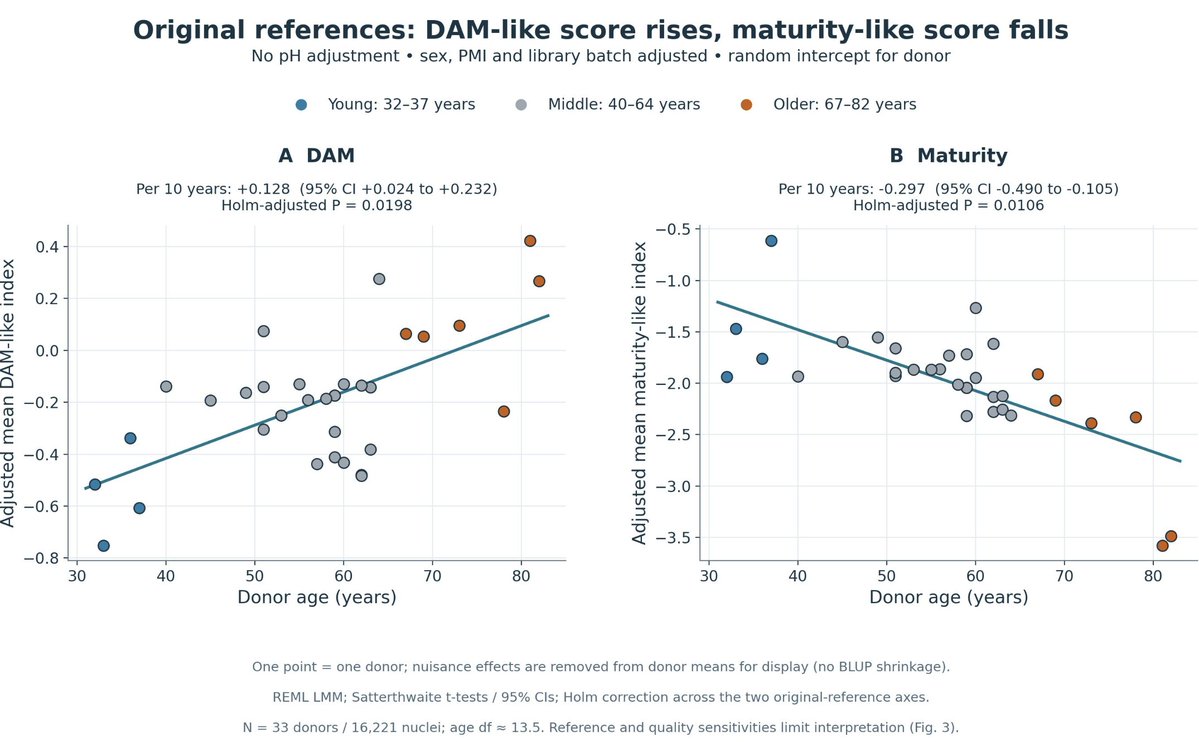
@MKarlstetterPhDGreat question. Thanks. I followed up by examining age as a continuous variable in two public human microglial datasets. In GSE254569 (33 control donors, ages 32–82), older age was associated with higher DAM-like and lower maturity-like scores. In the larger PsychAD dataset (300 control donors, ages 20–89), the maturity-like score also decreased with age, whereas the overall age association for the DAM-like score was not significant (I don't know why). For the maturity-like score, the results are compatible with a gradual age-related shift rather than a clearly defined late-life jump. The curves bend somewhat at older ages, but we did not find robust statistical evidence for an abrupt change or late-life acceleration. Both figures show new, unpublished exploratory analyses performed in response to your question, using published datasets. The scores are based on mouse-derived reference signatures mapped to human orthologues. It would be interesting to use human-derived maturation reference, which would be easy. With AI assistance, RFind can be applied extremely easily to a wide range of transcriptomic datasets, just like this. I hope you try it! Data sources: GSE254569: PsychAD: Lee et al., Nature Genetics (2026), CELLxGENE dataset ID: 09642770-9a4c-4fe6-9f45-67e1249adc3310261
Javier Santoyo@jsantoyoSingle-cell transcriptomic and genomic changes in the ageing human brain. #SingleCel #scRNAseq #Transcriptomics #Genomics #HumanBrain @nature2311257.5K
In Silico Single-Cell Transcriptomic Analysis Reveals Senescence-Associated Programs’ Progress Along the Normal–Adenoma–Carcinoma Sequence in Colorectal Cancer0681.1K
Christian Staehr@ChrStaehrCheck out our new spatial #transcriptomics and #proteomics study characterizing changes in the vascular wall 24h post-#stroke!Stroke AHA/ASA @StrokeAHA_ASA#STROKE: Spatial transcriptomics of endothelial and mural cells in the peri-infarct brain cortex after ischemia stroke-reperfusion in mice suggest blood-brain barrier disruption and loss of the vascular tone. @matchkov @HalvorOG @ChrStaehr #AHAJournals311444.4K
Stroke AHA/ASA@StrokeAHA_ASA#STROKE: Spatial transcriptomics of endothelial and mural cells in the peri-infarct brain cortex after ischemia stroke-reperfusion in mice suggest blood-brain barrier disruption and loss of the vascular tone. @matchkov @HalvorOG @ChrStaehr #AHAJournals111386.8K
Single-cell #transcriptomics and #proteomics profiling of #COVID19 samples reveals immune and HSPC changes that are differentially associated with disease severity @HaniffaLab @ClatworthyLab @MarioniLab @UniofNewcastle @sangerinstitute @humancellatlas072233
Stephanie Hicks, PhD@stephaniehicksVery excited to share new work where we used #snRNAseq and #spatial #transcriptomics to better understand the molecular landscape of the human hippocampus (HPC)! Huge thanks to Erik Nelson @CMM_JHU & @MadhaviTippani @LieberInstitute who led the work! 🔗1208913.5K
Can aging be accelerated in a dish — enough to test interventions faster? An Aging Cell study kept human fibroblasts in long-term post-mitotic culture and found that they developed transcriptomic and epigenetic features resembling in vivo aging. In this model, metformin attenuated several aging-associated signatures, while rapamycin showed a more limited effect. Early in vitro evidence only — but a potentially useful platform for testing geroprotective compounds. #Aging #Longevity #Metformin00030
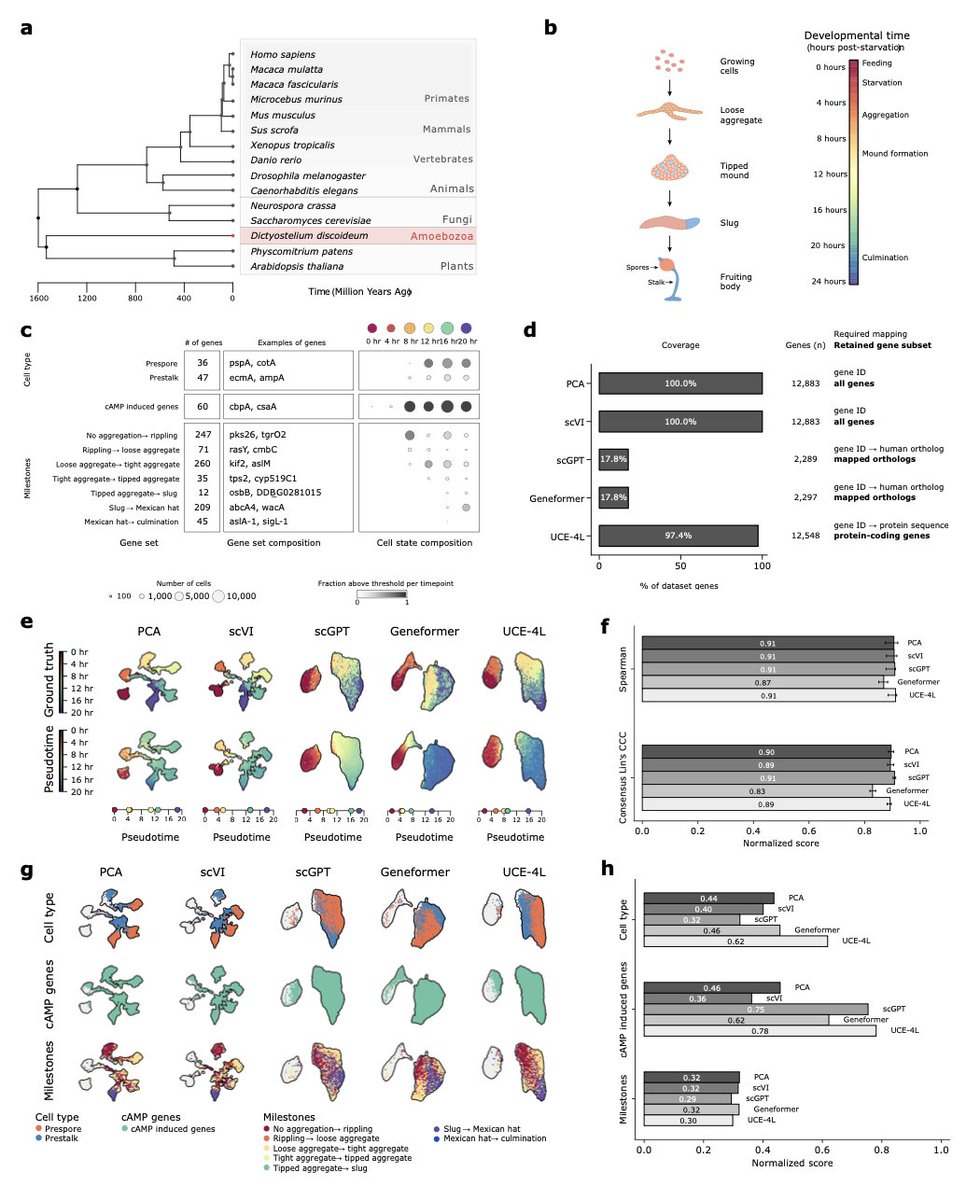
Biology+AI Daily@BiologyAIDailySingle-cell foundation models transfer across deep evolutionary distances 1. The study tests whether single-cell foundation models trained mostly on vertebrate data can transfer zero-shot to organisms separated from humans by deep evolutionary time: Dictyostelium discoideum (~1.2 billion years) and Caenorhabditis elegans (~600 million years), with no retraining, fine-tuning, or label supervision. 2. A key result is that useful biological structure survives these distances: embeddings from Geneformer, scGPT, and especially UCE recover developmental progression (via diffusion pseudotime) and preserve organism-specific identities such as Dictyostelium prespore/prestalk states and C. elegans tissue/lineage structure. 3. The paper argues that cross-species transfer is governed as much by gene representation as by model pretraining: fixed human-vocabulary models (Geneformer, scGPT) require ortholog mapping and end up using only ~17–18% of measured genes in both atlases, even after a multi-resource orthology pipeline and filtering. 4. In contrast, UCE uses protein-sequence-derived gene representations (ESM-2 protein embeddings plus genome-position-aware tokenization), enabling ~97% gene coverage in both organisms (12,548/12,883 genes in Dictyostelium; 19,720/20,222 genes in C. elegans), highlighting “gene accessibility” as a measurable dimension of model usability and performance. 5. Developmental ordering is context dependent: in Dictyostelium, all methods (including PCA and scVI) recover time well, consistent with a strong temporal transcriptomic signal; in C. elegans, UCE-4L shows the strongest agreement with embryo time estimates (higher rank agreement and concordance than PCA, scVI, Geneformer, and scGPT). 6. For discrete biological annotations (avgBIO = mean of NMI, ARI, label ASW), UCE-4L is the most consistent method across panels, ranking first on 5 of 6 headline annotation tasks; its clearest advantage is Dictyostelium cell type, where ortholog mapping discards most known markers. 7. The paper separates “coverage” from “representation” using a control: restricting UCE-4L to the Tier 1–2 ortholog-available gene pool. This largely removes UCE’s Dictyostelium cell-type advantage (because only 2% of curated markers survive ortholog mapping), but UCE remains competitive or leading on several other tasks even under the same gene restriction, suggesting protein-based encoding contributes beyond mere gene count. 8. Strong baselines still matter: PCA/scVI (species-native, full-gene) can match or approach pretrained models on some endpoints, and conventional PCA preprocessing (HVG selection, normalization, log1p, scaling) changes conclusions—improving several annotation scores while weakening pseudotime ordering—reinforcing that benchmark outcomes depend on endpoint and preprocessing choices. 9. Model configuration sensitivity is real: UCE checkpoint depth behaves differently across organisms (UCE-33L underperforms UCE-4L in Dictyostelium but is similar in C. elegans). Exploratory protein-space calibration partially rescues UCE-33L in Dictyostelium, suggesting distribution shift in protein-embedding space can affect downstream cell embeddings. 10. The authors propose reporting requirements for cross-species benchmarks: always report gene coverage after all input filters, marker retention, mapping workflow details, species-native baselines, and coverage-aligned controls—because downstream “performance” can otherwise conflate representational quality with how much of the transcriptome the model is allowed to see. 💻Code: 📜Paper: #SingleCell #scRNAseq #FoundationModels #ComputationalBiology #Bioinformatics #CrossSpecies #Evolution #GeneRepresentation #ProteinEmbeddings #DevelopmentalBiology09457.2K
David Exposito-Alonso@DExpositoAlonso1/4 Has #brain gene expression evolved differently in humans? See our latest paper @ScienceMagazine in collaboration with Trygve, Nik, and Rebecca @AllenInstitute and @jhtsong (also in @ChrisAWalsh1 lab) using #transcriptomics of #neocortex in primates!2299827.4K- Show more posts